
Explore the layers of the generative AI technology stack and its components for building AI-powered applications.
The Generative AI Technology Stack
Generative AI
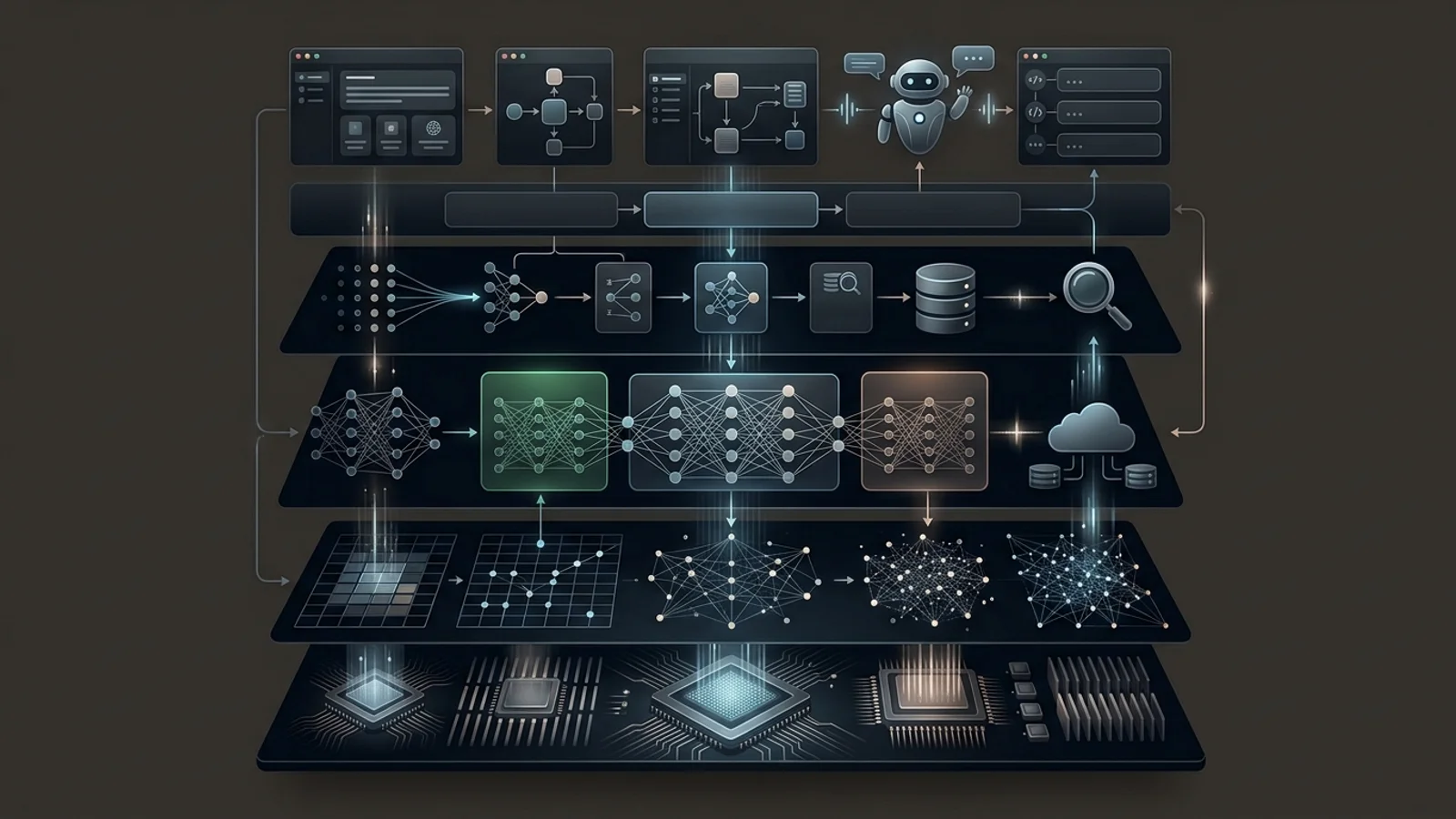
The generative AI technology stack is the collection of models, infrastructure, data systems, development frameworks, and application technologies that work together to build modern AI-powered products. Understanding this stack is essential because generative AI applications rarely depend on a single model or technology. Instead, they are built through multiple layers that transform raw data and computational resources into intelligent applications capable of generating text, images, audio, video, code, and other forms of content.
At the foundation of the stack are computing infrastructure and data. Powerful GPUs and specialized AI accelerators provide the computational resources required to train and run large models, while high-quality datasets provide the information models need to learn patterns, relationships, and representations. Above this foundation, machine learning frameworks, model architectures, and training systems enable developers and researchers to build and optimize increasingly capable generative models.
The upper layers of the stack focus on turning foundation models into practical AI systems. Model APIs, inference platforms, embedding models, vector databases, retrieval systems, orchestration frameworks, evaluation tools, and application interfaces allow developers to connect models with real-world data and workflows. This is where technologies such as retrieval-augmented generation, tool calling, agents, and structured outputs become important.
A useful way to understand the generative AI ecosystem is to view it as a layered architecture. Each layer solves a different problem, from computation and data management at the bottom to models, application infrastructure, and user-facing experiences at the top. These layers are interconnected, meaning that improvements in one layer can significantly influence the capabilities, cost, reliability, and scalability of the entire system.
In simple terms: the generative AI technology stack is a layered system that combines computing power, data, AI models, development infrastructure, and application technologies to transform artificial intelligence models into useful real-world products.
Stack Architecture
The generative AI stack can be divided into several interconnected layers. Each layer provides capabilities required by the layers above it. While the exact architecture varies between companies and applications, a typical generative AI system includes infrastructure, data, model development, foundation models, model access, application infrastructure, and the final user experience.
This layer provides the computational resources required to train, fine-tune, and serve generative AI models. GPUs, AI accelerators, high-performance networking, storage systems, and cloud infrastructure form the foundation of modern AI workloads.
Data provides the information from which AI systems learn and retrieve knowledge. This layer can include training datasets, documents, databases, knowledge bases, metadata, embeddings, and real-time application data.
Machine learning frameworks, distributed training systems, optimization techniques, and model architectures belong to this layer. These tools enable teams to train, fine-tune, evaluate, and optimize generative models.
Foundation models are large, general-purpose models trained on broad datasets. They provide core capabilities such as language understanding, reasoning, image generation, speech processing, and code generation that can be adapted for specific applications.
This layer makes models accessible to applications through inference servers, APIs, model gateways, and deployment platforms. It focuses on serving models efficiently while controlling latency, reliability, and computational cost.
Application infrastructure connects models with external systems and real-world information. Retrieval systems, vector databases, tool calling, agents, memory, workflow orchestration, and evaluation components commonly operate at this level.
Foundation
Generative AI requires significant computational resources because modern models can contain billions or even hundreds of billions of parameters. Training these systems involves processing enormous datasets through neural networks repeatedly, while serving them requires enough computing capacity to respond to users efficiently.
GPUs have become central to generative AI because they can perform the large-scale parallel mathematical operations used by neural networks. Specialized AI accelerators can also be used for training and inference. Alongside compute, high-speed networking, distributed storage, memory, and orchestration systems are required to operate AI workloads at scale.
Cloud platforms have made this infrastructure accessible to development teams without requiring them to build large physical data centers. Organizations can provision compute resources when needed, scale them according to demand, and deploy models closer to their users.
Key idea: compute infrastructure determines how efficiently generative AI models can be trained, deployed, and scaled.
Data
Data is one of the most important components of the generative AI stack. The quality, diversity, structure, and relevance of data can strongly influence the performance of an AI system. Data may be used during model training, model adaptation, retrieval, evaluation, or directly inside an application workflow.
In enterprise applications, data often comes from internal documents, databases, APIs, knowledge bases, customer records, and other business systems. Retrieval-augmented generation can connect this information to a language model without requiring the model itself to be retrained every time the underlying knowledge changes.
Embeddings are another important part of this layer. They transform information such as text, images, or other content into numerical representations that capture semantic relationships. These representations can then be stored in vector databases and searched when an application needs relevant information.
Models
Foundation models sit near the center of the modern generative AI stack. These models are trained on large and diverse datasets and are designed to support a broad range of tasks. Large language models, vision-language models, image generation models, speech models, and multimodal systems are examples of foundation-model technologies.
Developers can interact with these models directly through APIs or adapt them for specialized use cases. Depending on the application, adaptation may involve prompt engineering, fine-tuning, parameter-efficient fine-tuning, retrieval-augmented generation, or additional application logic.
The model itself, however, is only one component of a production AI system. A powerful model can still produce unreliable results if the surrounding system lacks high-quality data, appropriate retrieval, evaluation, security, monitoring, and well-designed application logic.
Application Layer
The application layer is where generative AI becomes useful to end users. Developers combine models with business logic, databases, APIs, user interfaces, retrieval systems, tools, and workflows to create complete products rather than simply exposing a model response.
For example, an enterprise knowledge assistant may combine a language model with document ingestion, embeddings, a vector database, retrieval, permission checks, conversation history, and a web interface. The model generates the response, but the surrounding architecture determines what information the model receives and how the final answer is delivered.
In practice: successful generative AI products are usually systems built around models, not models operating in isolation.
Putting It Together
The different layers of the generative AI stack work together as a pipeline. Compute infrastructure provides the resources, data provides information, model-development technologies create and optimize models, and foundation models provide general intelligence capabilities.
Application infrastructure then connects those capabilities to external knowledge, tools, and business systems. Finally, an application interface presents the resulting capabilities to users. This architecture allows organizations to build systems that are more useful, adaptable, and connected to real-world workflows.
| Layer | Primary Role | Examples |
|---|---|---|
| Infrastructure | Provides computational resources | GPUs, accelerators, cloud platforms |
| Data | Provides knowledge and training information | Documents, databases, datasets, embeddings |
| Models | Generates predictions and content | LLMs, multimodal models, image models |
| AI Infrastructure | Connects models with information and tools | RAG, vector databases, agents, APIs |
| Applications | Delivers AI capabilities to users | Assistants, copilots, AI platforms |
Model Development
Beneath modern generative AI models is a layer of machine learning frameworks and training infrastructure that enables developers and researchers to design, train, fine-tune, and optimize neural networks. This layer provides the mathematical and computational foundation required to transform large datasets into capable generative models.
Deep learning frameworks provide the building blocks for constructing neural networks, defining model architectures, calculating gradients, and optimizing millions or billions of parameters. They also provide access to hardware acceleration, automatic differentiation, distributed training, and other capabilities required for large-scale AI development.
Training a generative model typically involves processing massive amounts of data through a neural network and repeatedly adjusting its parameters to reduce prediction errors. The process can require substantial compute, memory, storage, and distributed infrastructure, particularly when models contain billions of parameters.
Defines how information moves through the neural network. Modern generative systems commonly use architectures designed to efficiently process sequences, images, audio, or multiple modalities.
Adjusts model parameters during training so the model progressively improves its ability to learn patterns from the training data.
Allows training workloads to be distributed across multiple GPUs or machines, making it possible to train models that would be impractical to process on a single device.
Adapts an existing pretrained model to a specialized task, domain, behavior, or style without requiring the model to be trained entirely from scratch.
Key idea: training infrastructure turns data and computational resources into capable AI models, while optimization and fine-tuning determine how those models are adapted for specific requirements.
Model Interaction
Once a generative AI model has been trained or selected, applications need a reliable way to interact with it. Model APIs and inference infrastructure provide this connection by accepting application inputs, executing model inference, and returning generated outputs.
An inference request may contain a text prompt, conversation history, retrieved documents, images, structured data, or instructions for using external tools. The inference system processes these inputs through the selected model and generates an output that can be consumed by the application.
Production inference introduces engineering challenges that go beyond simply running a model. Teams must consider latency, throughput, GPU utilization, context length, concurrency, reliability, model availability, and operational cost. These factors become increasingly important as the number of users and AI requests grows.
| Component | Purpose | Production Concern |
|---|---|---|
| Model API | Provides programmatic access to a model | Authentication and reliability |
| Inference Server | Executes model requests | Latency and throughput |
| Model Gateway | Routes requests between models or providers | Routing, availability, and cost |
| Monitoring | Tracks model and application behavior | Quality, errors, latency, and usage |
Retrieval & Knowledge
Foundation models have broad capabilities, but many real-world applications require access to information that is private, specialized, or frequently updated. Retrieval technologies extend generative AI applications by allowing them to search external knowledge before generating a response.
The process often begins by converting documents or other information into embeddings. These numerical representations capture semantic relationships between pieces of information. The resulting vectors can be stored in a vector database and searched using semantic similarity when a user submits a query.
Retrieved information can then be provided to the generative model as additional context. This architecture is commonly known as retrieval-augmented generation, or RAG. It allows an application to ground model responses in a controlled knowledge source without requiring every piece of information to be encoded directly into the model's parameters.
Step 01
Convert documents or other content into numerical representations.
Step 02
Search for information that is semantically relevant to the user's request.
Step 03
Provide the retrieved context to the model to produce a grounded response.
Orchestration
More advanced generative AI systems require more than a single model request. Orchestration technologies coordinate models, retrieval systems, databases, APIs, tools, memory, and business logic so that an AI application can complete multi-step tasks.
Tool calling allows a model to request actions from external systems. For example, an AI assistant may use a search service to retrieve information, query a database, call a business API, execute a permitted function, or interact with another software system. The model determines what information or action is needed while the surrounding application controls how that action is executed.
AI agents build on these capabilities by combining reasoning, tool use, state, and multi-step workflows. Instead of generating a single response, an agentic system can interpret a goal, decide which actions are required, execute tools, inspect results, and continue until the task reaches an appropriate stopping condition.
Key idea: orchestration is the layer that turns individual AI capabilities into coordinated workflows capable of performing useful multi-step tasks.
Production Layer
Building a generative AI application is only the beginning. Production systems must also be evaluated, monitored, secured, and continuously improved. Unlike traditional software, AI systems can produce different outputs for similar inputs, making quality measurement an important part of the technology stack.
Evaluation can measure factors such as factual accuracy, relevance, instruction following, retrieval quality, response consistency, latency, and cost. Automated evaluations can be combined with human review to identify weaknesses and compare different models, prompts, retrieval strategies, and application configurations.
Security is equally important. Production AI applications may process sensitive business information and interact with external tools, so developers need appropriate authentication, authorization, input validation, data protection, access controls, and safeguards against prompt injection and other application-level risks.
Measures whether the system produces accurate, relevant, reliable, and useful results.
Protects models, data, users, tools, and application workflows from unauthorized or unsafe interactions.
Provides visibility into requests, failures, latency, costs, model behavior, and system performance.
Application Architecture
The application development layer brings together models, data, retrieval, tools, business logic, and user interfaces to create complete generative AI products. This is the layer most application developers interact with because it transforms underlying AI capabilities into features that users can directly access and use.
A production application typically contains several services working together. A backend may manage authentication, prompts, model requests, database operations, retrieval, and tool execution, while a frontend provides the interface through which users communicate with the AI system. APIs connect these components and allow the application to integrate with external services.
Modern AI applications are increasingly designed as modular systems. Instead of embedding every capability inside a single component, developers separate responsibilities across services and workflows. This approach makes the system easier to maintain, test, scale, and improve as models and AI technologies evolve.
Manage authentication, application logic, model requests, databases, retrieval pipelines, tool execution, and other server-side operations.
Connect AI models and backend services with web applications, databases, business systems, and external software platforms.
Provide users with interfaces for interacting with AI assistants, copilots, content-generation tools, search systems, and other generative AI features.
Applies application-specific rules that determine what the AI system can access, what actions it can perform, and how generated results are processed.
Prompt Engineering
Prompts provide instructions and context that guide a generative model toward the desired behavior. In production applications, prompt engineering is more than writing a question for a chatbot. It involves designing structured instructions, defining model behavior, controlling available context, and specifying the expected output format.
Context management becomes especially important when an application uses retrieved documents, conversation history, user information, tool results, or other dynamic data. The application must determine which information should be included in the model's context and how that information should be organized.
Structured prompting can also help applications produce predictable outputs. Developers may require models to return specific fields, follow defined instructions, or produce machine-readable formats that can be processed by downstream application components.
Key idea: prompt engineering controls how an application communicates with its model, while context management determines what information the model receives when generating an output.
Memory & State
Many generative AI applications need to maintain information across interactions. Conversation history, user preferences, workflow state, previous tool results, and application-specific information can provide context that makes an AI system more useful and consistent.
Memory can be implemented in different ways depending on the application. Short-term conversational history may be maintained for the duration of a session, while longer-term information can be stored in databases or retrieved through semantic search when it becomes relevant.
State management is particularly important for agentic systems. An agent may need to track its current objective, previous actions, tool outputs, intermediate decisions, and remaining tasks. Managing this state explicitly helps make multi-step AI workflows more reliable and easier to debug.
Short-Term
Maintains information needed during an active conversation or workflow, such as recent messages, retrieved content, and intermediate results.
Long-Term
Stores useful information beyond a single interaction so it can be retrieved and applied in future sessions when appropriate.
Deployment
Moving a generative AI application from development to production introduces a new set of engineering requirements. The system must handle real user traffic, maintain acceptable response times, protect application resources, and operate within a sustainable infrastructure budget.
Scaling can involve increasing compute capacity, distributing requests across multiple instances, selecting models according to workload requirements, and optimizing inference. Smaller models may be appropriate for simple tasks, while larger models can be reserved for complex reasoning or high-value operations.
Cost optimization is therefore an architectural concern rather than simply a model-selection decision. Developers can reduce unnecessary computation through caching, efficient prompts, appropriate context selection, batching, model routing, and other system-level techniques.
| Optimization Area | Objective | Typical Approach |
|---|---|---|
| Inference | Reduce response time and compute usage | Efficient serving and model selection |
| Context | Avoid unnecessary model input | Relevant retrieval and concise prompts |
| Caching | Prevent repeated computation | Cache reusable results where appropriate |
| Scaling | Handle increasing workloads | Distributed services and dynamic capacity |
End-to-End Architecture
When these components are combined, the generative AI stack becomes a complete technology ecosystem rather than a collection of independent tools. Infrastructure provides the computational foundation, data supplies information, models provide generative capabilities, and application infrastructure connects those capabilities to real-world systems.
A typical production workflow may begin with a user request arriving through an application interface. The backend interprets the request, retrieves relevant information, constructs the appropriate context, and sends it to a selected model. The model generates an output, while application logic validates, processes, or enriches that output before it is returned to the user.
01
A user submits a request through the application interface.
02
The system gathers relevant context from available data sources.
03
The selected model processes the request and generates an output.
04
Application logic processes the result and delivers it to the user.
The bigger picture: the most capable generative AI applications are built by combining models with reliable infrastructure, high-quality data, retrieval, orchestration, security, evaluation, and thoughtful product design.
References & Further Reading
The following resources provide additional technical context on generative AI models, machine learning infrastructure, retrieval systems, foundation models, and modern AI application development.
Explore research and technical resources covering foundation models, large language models, multimodal AI, and modern generative AI architectures.
Learn more about the computing, GPU acceleration, distributed training, inference, and deployment infrastructure used to build large-scale AI systems.
Review technical concepts related to embeddings, vector databases, semantic search, retrieval pipelines, and grounding generative AI models with external knowledge.
Explore modern approaches to building production AI applications, including model APIs, orchestration, tool calling, agents, evaluation, observability, security, and scalable deployment.
Editorial note: Generative AI technologies evolve rapidly. Technical implementations, model capabilities, infrastructure choices, and recommended practices should be verified against current official documentation and research before production use.

Editor in Chief
Software engineer and full-stack developer building modern digital experiences, products, and ideas.
sudaisazlan.comReady to do everything better? Get daily tips, tricks, and tech guides from our expert team.
By clicking Sign Up, you confirm you are 16+ and agree to our Terms of Service and Privacy Policy.
Have fun. Be respectful. Feel free to criticize ideas, but not people.