
Explore the differences between RAG and fine-tuning in generative AI applications.
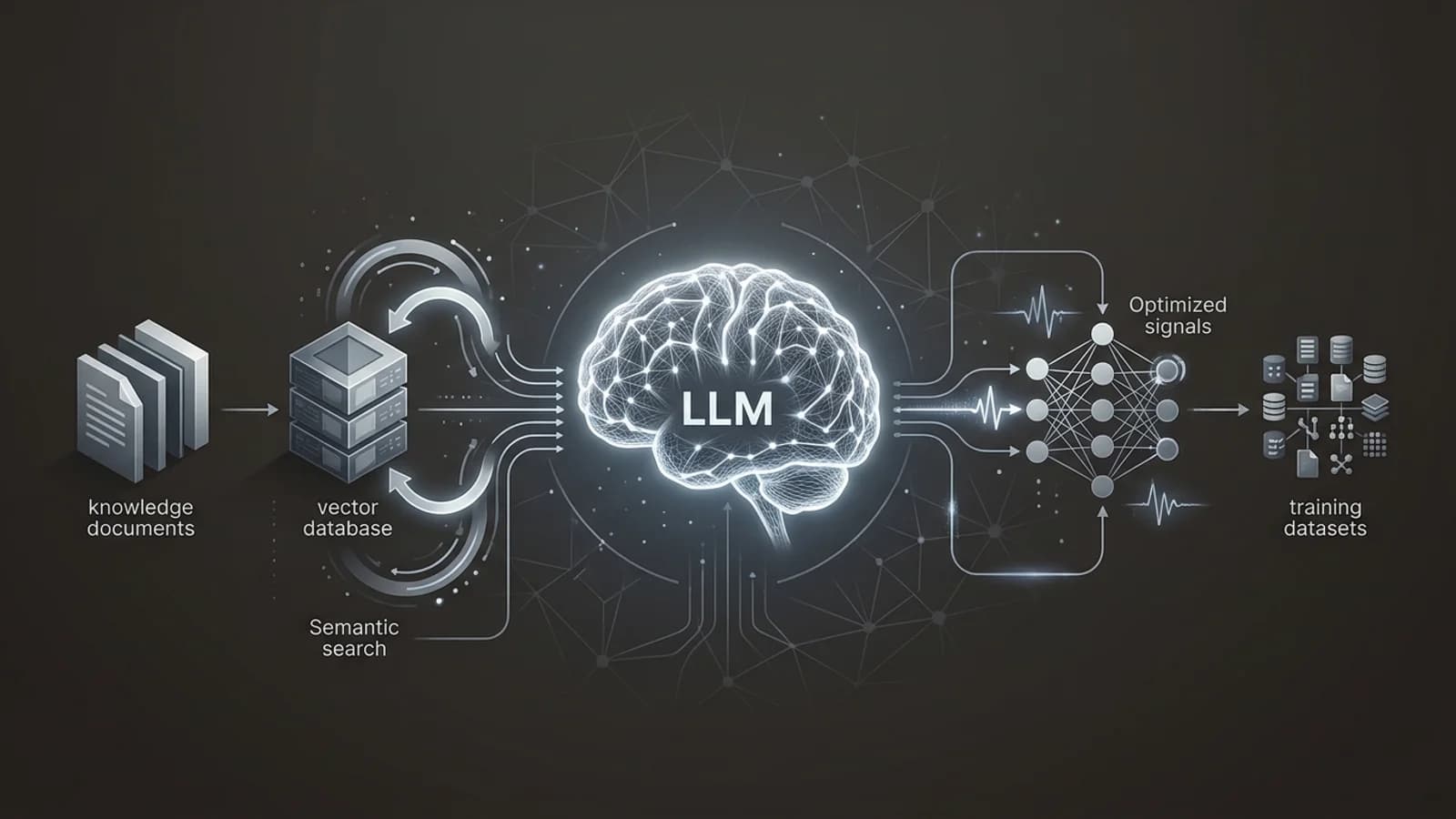
RAG vs. Fine-Tuning
Generative AI
Retrieval-Augmented Generation (RAG) and fine-tuning are two widely used approaches for improving the capabilities of generative AI applications. Although both can help a model produce more useful and domain-specific responses, they solve fundamentally different problems.
RAG gives a language model access to external information at inference time by retrieving relevant documents or data and providing that information as context. Fine-tuning, on the other hand, modifies a model's learned parameters by training it further on a specialized dataset.
Choosing between RAG and fine-tuning depends on factors such as the type of knowledge involved, how frequently that knowledge changes, the desired behavior, available infrastructure, cost, latency, and the level of control required.
In simple terms: RAG gives an AI model access to relevant information when it answers, while fine-tuning teaches the model to behave differently by training it on additional examples.
Retrieval-Augmented Generation is an architecture that combines information retrieval with generative AI. Instead of relying entirely on the knowledge encoded in a model's parameters, a RAG system retrieves relevant external information and supplies it to the model as context before generating a response.
A typical RAG system converts documents or other knowledge sources into searchable representations, stores them in a retrieval system such as a vector database, and retrieves the most relevant information when a user submits a query.
The retrieved content is then added to the model's prompt. The language model uses that contextual information to generate an answer that is grounded in the available knowledge source.
Step 01
Collect documents, web content, databases, or other knowledge sources.
Step 02
Search for information that is relevant to the user's query.
Step 03
Add the retrieved information to the model's context.
Step 04
Generate an answer using the retrieved information and the model.
Fine-tuning is a machine learning technique in which a pretrained model is further trained on a smaller, specialized dataset. The additional training adjusts some or all of the model's parameters so that it performs better for a particular task, domain, style, or behavior.
Instead of providing external knowledge during every request, fine-tuning changes the model itself. The model learns patterns from the examples in the fine-tuning dataset and incorporates those patterns into its learned parameters.
Fine-tuning can be useful when the primary goal is to change how a model behaves rather than simply giving it access to changing information. For example, organizations may fine-tune a model to follow a particular output format, adopt a specialized communication style, or perform a narrow task consistently.
Key idea: fine-tuning changes the model's learned behavior, while RAG primarily changes the information available to the model during generation.
A RAG pipeline typically begins with a collection of documents. These documents are processed, divided into smaller chunks, converted into embeddings, and stored in a retrieval system. When a user asks a question, the system searches for the chunks that are most relevant to the query.
The retrieved information is then passed to a language model along with the original question. The model uses the supplied context to formulate its response.
Fine-tuning starts with a pretrained model and a carefully prepared dataset. The dataset contains examples that represent the desired task, behavior, style, or domain. During training, the model adjusts its parameters to better reproduce the patterns represented by those examples.
Once fine-tuning is complete, the resulting model can be used for the target task without necessarily retrieving the same training examples at inference time. The learned behavior becomes part of the model's updated parameters.
Create high-quality examples that represent the desired behavior or task.
Continue training the pretrained model on the specialized dataset.
Use the adapted model for the intended task or workflow.
The most important distinction is where the additional information or behavior is introduced. RAG provides external context at inference time, while fine-tuning modifies the model through additional training.
| Factor | RAG | Fine-Tuning |
|---|---|---|
| Primary purpose | Provide external knowledge | Adapt model behavior or capabilities |
| How it works | Retrieves relevant context | Updates model parameters through training |
| Updating knowledge | Generally easier to update | Usually requires another training process |
| Best suited for | Dynamic or private knowledge | Specialized behavior and task performance |
| External knowledge required at inference | Yes | Not necessarily |
| Infrastructure | Requires retrieval infrastructure | Requires training infrastructure |
RAG is usually the better choice when the AI system needs access to external information that changes frequently or needs to remain separate from the model itself.
RAG allows the underlying knowledge source to be updated without retraining the language model every time information changes.
Organizations can connect AI systems to internal documents, knowledge bases, policies, manuals, and other controlled information sources.
RAG is particularly useful when answers need to be grounded in a specific collection of documents or reference material.
Good rule of thumb: if the main problem is that the model does not have access to the right information, start by considering RAG.
Fine-tuning becomes more attractive when the primary objective is to change or improve a model's behavior rather than simply provide it with additional information.
Fine-tuning can help a model consistently follow a particular response style, structure, or formatting pattern.
A model can be adapted for a narrow task where consistent task-specific behavior is important.
Fine-tuning can improve how a model handles specialized terminology, patterns, and workflows when sufficient high-quality training examples are available.
Models can be trained to produce structured responses that match the requirements of a particular application.
Good rule of thumb: if the main problem is that the model does not behave the way you need, fine-tuning may be worth considering.
Yes. RAG and fine-tuning are not mutually exclusive techniques. In sophisticated AI systems, they can be combined to address different requirements.
Fine-tuning can be used to teach a model how to behave, respond, or follow a specialized task format, while RAG can provide the model with current, private, or domain-specific information at inference time.
Imagine a customer-support AI system for a company. Fine-tuning could help the model consistently follow the organization's preferred response style, while RAG retrieves the latest product documentation and support policies.
Cost and operational complexity can strongly influence the choice between RAG and fine-tuning. Neither approach is universally cheaper or faster because the final architecture depends on the model, dataset, retrieval system, infrastructure, traffic, and application requirements.
| Consideration | RAG | Fine-Tuning |
|---|---|---|
| Initial setup | Retrieval pipeline and knowledge infrastructure | Dataset preparation and training workflow |
| Knowledge updates | Usually simpler | May require additional training |
| Maintenance | Maintain data and retrieval quality | Maintain datasets and model versions |
| Runtime complexity | Includes retrieval and context construction | Primarily model inference after training |
One of the most common mistakes is treating RAG and fine-tuning as interchangeable solutions. They address different layers of an AI system, so selecting the wrong approach can increase complexity without solving the underlying problem.
If the primary requirement is access to frequently changing knowledge, a retrieval-based architecture is often more appropriate than repeatedly retraining a model.
Retrieved information can improve factual grounding, but it does not automatically teach a model a new consistent behavior or output style.
Poor documents can produce poor retrieval results, while low-quality fine-tuning examples can teach undesirable behaviors. Data quality is critical for both approaches.
Both RAG and fine-tuning should be evaluated against representative tasks, failure cases, accuracy requirements, latency constraints, and the actual needs of the application.
The best approach depends on the problem you are trying to solve. A useful starting point is to separate the need for additional knowledge from the need for different model behavior.
Choose RAG when
Choose Fine-Tuning when
RAG and fine-tuning are two important building blocks for modern generative AI applications, but they operate at different levels. RAG extends a model with access to external information, while fine-tuning adapts the model itself for specialized behavior or tasks.
For many practical AI applications, RAG is a strong starting point when the primary challenge is providing reliable access to domain-specific or changing information. Fine-tuning becomes more relevant when the model's behavior, style, or performance on a specialized task needs to be improved.
The most effective architecture is ultimately determined by the application's requirements. In some systems, RAG is sufficient. In others, fine-tuning provides the necessary specialization. For advanced applications, combining both approaches can provide a powerful balance between specialized behavior and access to current external knowledge.
The bottom line: use RAG when you need to give your model better access to information, use fine-tuning when you need to change how the model behaves, and consider combining both when your application requires specialized behavior and continuously updated knowledge.
Cost is an important consideration when designing a generative AI application. However, comparing RAG and fine-tuning purely by price can be misleading because the total cost depends on the model, dataset size, infrastructure, application traffic, retrieval requirements, and maintenance workload.
RAG generally shifts more of the complexity toward the application layer. A production RAG system may require document processing, embedding generation, vector storage, retrieval, reranking, context management, and monitoring. The advantage is that the underlying knowledge can often be updated without retraining the model.
Fine-tuning shifts complexity toward the training process. Teams need suitable training data, an appropriate training strategy, evaluation procedures, model versioning, and infrastructure capable of supporting the training workflow. Once the model is trained, however, the inference architecture may be simpler than a retrieval-heavy system.
RAG
Fine-Tuning
Engineering principle: the cheaper approach is not always the better architecture. The right solution minimizes total operational complexity while meeting the application's accuracy, reliability, latency, and maintenance requirements.
Performance is another factor that should be evaluated before selecting an architecture. RAG introduces additional processing during a request because the system must retrieve relevant information before generating a response.
A retrieval pipeline may involve query transformation, embedding generation, vector search, metadata filtering, reranking, and context construction. Each additional stage can contribute to overall latency. Efficient retrieval infrastructure and careful system design can reduce this overhead.
Fine-tuned models do not require retrieval for every request when the desired behavior has already been incorporated into the model. This can simplify the runtime path, although the actual performance depends on the model size, serving infrastructure, quantization, batching, and other deployment factors.
| Performance Factor | RAG | Fine-Tuning |
|---|---|---|
| Retrieval overhead | Yes | No retrieval required by default |
| Context processing | Additional context may increase input processing | Depends primarily on the request and model |
| Runtime architecture | Retrieval plus generation | Primarily generation |
| Optimization focus | Retrieval quality and pipeline efficiency | Model and inference optimization |
Data quality is critical for both RAG and fine-tuning, but the type of data required is different. RAG generally requires a reliable knowledge source that can be searched effectively, while fine-tuning requires examples that demonstrate the behavior or task the model is expected to learn.
For RAG, the quality of document processing has a direct impact on retrieval. Poorly structured documents, inappropriate chunk sizes, duplicated content, missing metadata, or weak retrieval strategies can reduce the quality of the final response.
For fine-tuning, training examples need to accurately represent the desired behavior. Inconsistent, noisy, irrelevant, or poorly constructed examples can reduce performance or teach undesirable patterns.
Focuses on trustworthy information that the system can retrieve and provide as context.
Focuses on examples that demonstrate how the model should perform a task or behave in a particular situation.
A generative AI system should be evaluated not only by how well it works when it is first launched, but also by how easy it is to maintain as the application grows.
RAG can provide a flexible approach for organizations whose knowledge changes frequently. Teams can update the underlying knowledge repository while keeping the same base model. However, maintaining a production RAG system still requires monitoring retrieval quality, document freshness, indexing pipelines, access controls, and context quality.
Fine-tuned systems require a different maintenance strategy. As the application's requirements change, teams may need to update datasets, retrain or further adapt models, evaluate new versions, and manage compatibility between model versions and production systems.
How frequently does the information change?
How often will the model or behavior need to change?
What signals will be used to detect failures?
Can the architecture handle growing users and data?
Security and privacy should be considered from the beginning when developing either a RAG or fine-tuned AI system. The architecture determines how sensitive information is stored, processed, retrieved, and exposed to the model.
RAG systems require careful control over the information retrieval layer. Access permissions, document-level authorization, metadata filtering, and protection against inappropriate retrieval are important when dealing with private organizational information.
Fine-tuning introduces different considerations because training data is incorporated into the model's learned parameters. Sensitive information should therefore be handled carefully, and organizations need appropriate policies for data preparation, model training, evaluation, deployment, and retention.
Security principle: choose an architecture based not only on model capability, but also on how sensitive information needs to be controlled throughout the complete AI pipeline.
A common engineering mistake is introducing fine-tuning or a complex RAG architecture before clearly identifying the application's actual requirements. The better approach is to define the problem first and then select the simplest architecture capable of meeting the desired quality and reliability targets.
For many applications, a strong base model combined with well-designed prompts may be enough. If the system needs reliable access to external or frequently changing information, RAG can be introduced. If the model needs consistent specialized behavior and sufficient training examples are available, fine-tuning may then be evaluated.
Determine whether the challenge is missing knowledge, incorrect behavior, inconsistent output, or another system-level issue.
Define the accuracy, reliability, latency, cost, and quality requirements before selecting an architecture.
Select prompting, RAG, fine-tuning, or a combination based on the evidence from your requirements and evaluation.
Continuously evaluate the system and improve the components that actually limit performance.
Choosing between RAG and fine-tuning should be based on measurable results rather than assumptions. A system that looks impressive in a few examples may still perform poorly across a larger and more realistic evaluation dataset.
Evaluation should reflect the actual purpose of the application. For RAG, this means measuring both retrieval quality and the quality of the final generated response. For fine-tuning, evaluation should focus on whether the adapted model consistently performs the target task without introducing unwanted behavior.
Key point: evaluation should compare architectures using the same representative test cases, business requirements, and quality thresholds. This makes the final architecture decision evidence-driven rather than preference-driven.
There is no universal answer to the question of whether RAG or fine-tuning is better. The correct choice depends on what the application needs the model to know and what the model needs to learn to do.
A useful way to make the decision is to separate knowledge requirements from behavior requirements. If the primary challenge is giving the model access to information that exists outside its parameters, RAG is usually the more appropriate direction. If the challenge is changing how the model performs a task, fine-tuning may be more suitable.
| Requirement | Recommended Direction | Reason |
|---|---|---|
| Frequently changing knowledge | RAG | Information can be updated in the knowledge source. |
| Private organizational documents | RAG | Relevant information can be retrieved at query time. |
| Consistent output format | Fine-tuning or prompting | The requirement primarily concerns model behavior. |
| Specialized task behavior | Fine-tuning | Training examples can teach the desired task behavior. |
| Need for both knowledge and behavior adaptation | RAG + Fine-Tuning | Each technique addresses a different part of the problem. |
Before implementing either approach, answer the following questions. They can help identify whether your primary challenge is knowledge retrieval, model behavior, or a combination of both.
If yes, consider RAG or another retrieval-based architecture.
If yes, retrieving information from an updateable knowledge source is generally more practical than repeatedly retraining a model.
If yes, evaluate fine-tuning using a high-quality task-specific dataset.
Before introducing additional infrastructure or training, test whether better prompts, structured outputs, or improved context handling can solve the problem.
A hybrid architecture can combine fine-tuning for behavior with RAG for access to current or private information.
In production systems, RAG and fine-tuning do not necessarily compete with each other. They can be combined when an application requires both specialized model behavior and access to external knowledge.
For example, a customer-support assistant could use fine-tuning to improve its response style, classification behavior, or structured output format, while RAG provides access to current product documentation, policies, and support information.
01
02
03
04
05
The key idea: RAG can provide the information the model needs, while fine-tuning can influence how the model performs the task. These approaches solve different problems and can therefore complement each other.
RAG and fine-tuning are powerful techniques, but they serve different purposes in generative AI systems. Understanding that distinction is more important than treating one technique as universally better than the other.
The simplest rule: use RAG when you need to give a model better access to information, use fine-tuning when you need to change or specialize its behavior, and consider combining both when your application requires knowledge grounding and specialized behavior.
Generative AI
Two powerful approaches for improving generative AI systems. RAG connects models to external knowledge, while fine-tuning adapts model behavior through specialized training.
RAG
Fine-Tuning

Editor in Chief
Software engineer and full-stack developer building modern digital experiences, products, and ideas.
sudaisazlan.comReady to do everything better? Get daily tips, tricks, and tech guides from our expert team.
By clicking Sign Up, you confirm you are 16+ and agree to our Terms of Service and Privacy Policy.
Have fun. Be respectful. Feel free to criticize ideas, but not people.