
Explore the inner workings of Large Language Models and their complex processes.
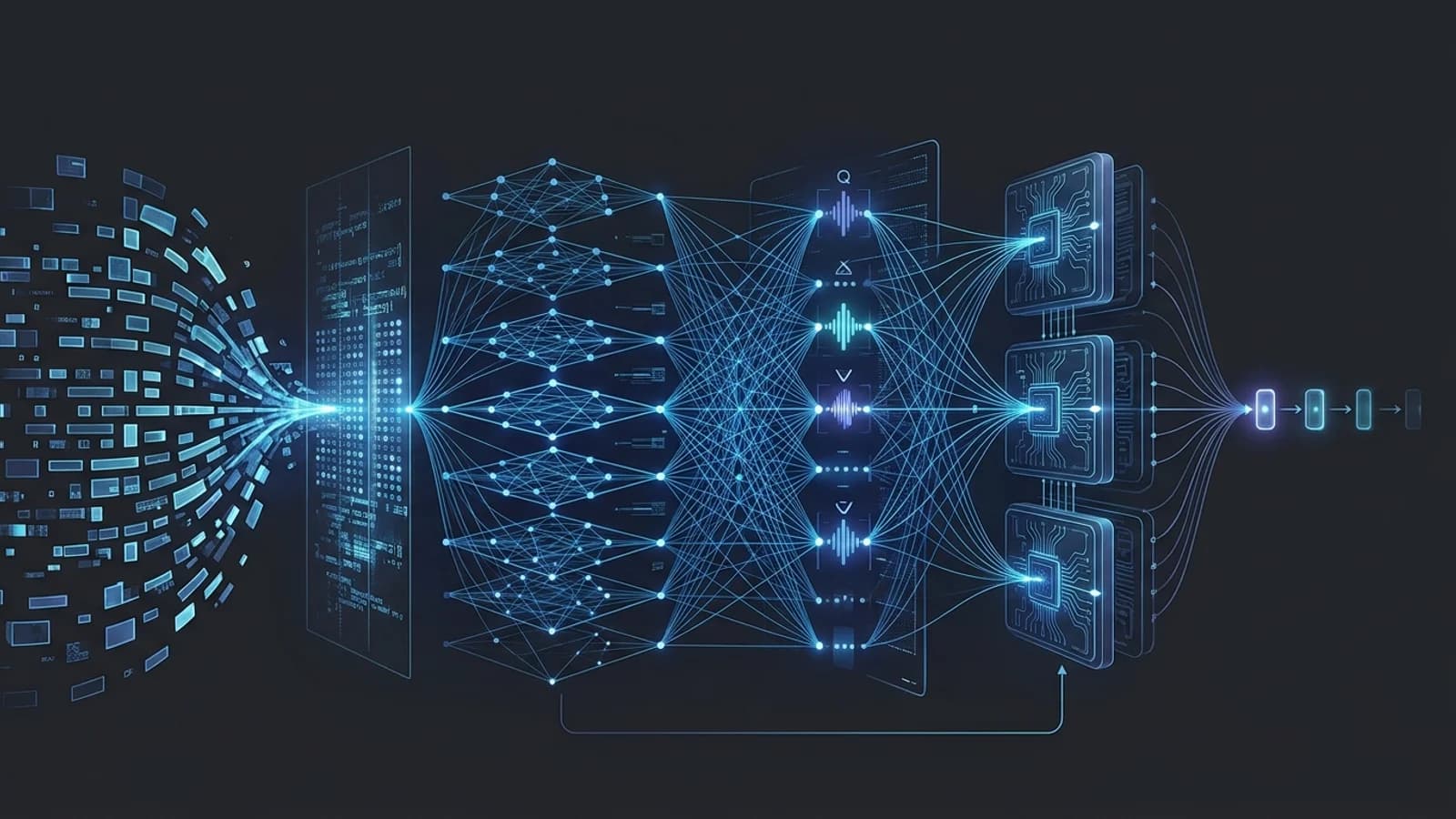
Inside Large Language Models
Large Language Models
A Large Language Model (LLM) may appear to understand and generate human language, but internally it operates through a complex sequence of mathematical transformations. When a user enters a prompt, the model does not process the text as humans do. Instead, it converts the input into numerical representations, processes those representations through many layers of a neural network, and ultimately predicts the tokens that should come next.
Modern LLMs are primarily built using the Transformer architecture. Inside a Transformer-based model, mechanisms such as token embeddings, positional information, self-attention, feed-forward neural networks, and normalization layers work together to transform the input into increasingly useful representations.
During inference, the model repeatedly calculates probabilities for possible next tokens. The selected token is added to the existing sequence, and the model performs another prediction. This process continues until the model produces a complete response or reaches a configured stopping condition.
01
The input text is divided into tokens that the model can process.
02
Tokens are converted into numerical vector representations.
03
Attention and neural network layers transform the representations and capture relationships between tokens.
04
The model calculates probabilities and selects the next token in the generated sequence.
These operations happen at an enormous scale. A modern language model may contain billions or even hundreds of billions of learned parameters. Those parameters are adjusted during training so the network becomes increasingly capable of modeling patterns in language and other forms of data.
In simple terms: an LLM converts text into numbers, transforms those numbers through many neural-network layers, calculates what token is most likely to come next, and repeats the process to generate a response.
Advanced Retrieval
Basic vector search is often enough for a simple RAG application, but production systems may require more advanced retrieval strategies. As knowledge bases become larger and user questions become more complex, retrieving the right information becomes one of the most important challenges in the entire RAG pipeline.
Advanced retrieval techniques improve the quality of the context provided to the language model by combining multiple search strategies, refining retrieved results, and adapting the retrieval process to the user's question.
Hybrid search combines semantic vector search with traditional keyword or lexical search. This allows a system to capture both conceptual similarity and exact terms, which can be particularly useful for technical documentation, product names, identifiers, and specialized terminology.
A reranker evaluates the initial retrieval results and reorders them according to their relevance to the user's query. This additional stage can help the system place the most useful documents or chunks at the top of the context supplied to the language model.
Query expansion generates alternative terms, phrases, or formulations related to the original question. These variations can improve recall when the wording of the user's query differs significantly from the wording used in the knowledge base.
Metadata filters allow the retrieval system to restrict results based on attributes such as document type, publication date, department, category, language, or access permissions before or alongside semantic retrieval.
Why it matters: better retrieval means better context, and better context gives the language model a stronger foundation for generating relevant and knowledge-grounded responses.
Input Processing
Before a language model can generate a response, it must convert human language into a numerical representation that its neural network can process. This process begins with tokenization and continues through embedding and positional representation.
A language model does not normally receive an entire sentence as a single unit. Instead, the input is divided into smaller pieces called tokens. A token may represent a complete word, part of a word, punctuation, or another frequently occurring text pattern. The exact tokenization depends on the tokenizer used by the model.
01
The user provides natural-language text as an instruction, question, or other form of input.
02
The tokenizer divides the input into smaller units that can be mapped to numerical token identifiers.
03
Token identifiers are transformed into dense numerical vectors that can be processed by the neural network.
Tokenization creates the units that the model works with internally. For example, a common word may be represented by a single token, while a less common word may be divided into multiple subword tokens. This allows the vocabulary to remain manageable while enabling the model to represent a very large range of text.
After tokenization, token identifiers are mapped to vectors through an embedding layer. These vectors provide the neural network with numerical representations that can be transformed throughout the model's layers. Tokens that occur in related contexts can develop representations that capture useful semantic and syntactic relationships.
Word and token order matters in language. The meaning of a sentence can change when the same words appear in a different arrangement. Transformer models therefore use positional information so that the network can distinguish between tokens based not only on their content but also on their position within the sequence.
The key idea: an LLM does not directly process raw human language. It transforms text into tokens, tokens into numerical representations, and then processes those representations through its neural network.
Transformer Architecture
The Transformer is the core architecture behind most modern large language models. Instead of processing language as a simple sequence of isolated words, Transformer layers allow the model to examine relationships between tokens and determine which parts of the input are most relevant to one another.
A large language model typically contains many Transformer layers stacked together. Each layer progressively transforms the numerical representation of the input, allowing the model to build increasingly sophisticated representations of language, context, relationships, and meaning.
01
Determines which tokens should receive more attention based on their relationships with other tokens in the context.
02
Applies additional learned transformations to each token representation to extract and refine useful patterns.
03
Help information and gradients move effectively through deep networks by preserving useful representations across layers.
04
Stabilizes the neural network computations and helps Transformer layers train and operate efficiently.
Self-attention is one of the most important mechanisms inside a Transformer. It allows the model to compare tokens within the current context and assign different levels of importance to them. This helps the model determine how one word or token relates to other parts of a sentence.
For example, in a sentence such as “The developer opened the application because it was failing,” the model needs to understand what “it” refers to. Attention mechanisms help the network identify relevant relationships rather than treating every token as equally important.
Transformer attention is commonly described using three learned representations: queries, keys, and values. A query represents what a token is looking for, keys represent information that can be matched against that query, and values contain the information that is ultimately combined into the resulting representation.
| Component | Purpose |
|---|---|
| Query | Represents what the current token is looking for in the context. |
| Key | Represents information that can be compared with a query. |
| Value | Provides the information that contributes to the updated token representation. |
After attention determines how information should be combined across the sequence, the resulting representations pass through a feed-forward neural network. This component applies additional mathematical transformations independently to each token representation.
The feed-forward network gives the Transformer additional capacity to learn complex patterns. While attention focuses heavily on relationships between tokens, the feed-forward component helps transform and refine the information represented by each token.
A single Transformer layer can learn useful relationships, but modern large language models use many layers to build increasingly complex representations. Information is repeatedly transformed as it moves through the network.
Earlier layers may capture relatively simple linguistic patterns, while deeper layers can represent more complex contextual relationships. The exact behavior differs across models, but the overall principle is that depth gives the network more computational capacity for transforming the input.
The key idea: Transformer layers repeatedly transform token representations using attention and neural-network computations. Through many stacked layers, an LLM can build increasingly rich representations of the context before producing its next-token prediction.
References & Further Reading
Understanding what happens inside a large language model requires connecting several areas of modern artificial intelligence, including tokenization, embeddings, neural networks, attention mechanisms, Transformer architecture, language modeling, and next-token prediction. The following foundational resources can help readers explore these concepts in greater technical depth.
01
Study the Transformer architecture to understand self-attention, positional information, encoder-decoder structures, and the foundation of modern language models.
02
Explore how attention allows models to determine relationships and dependencies between tokens within a context window.
03
Learn how large language models are trained on large-scale datasets and optimize millions or billions of parameters to predict language patterns.
04
Explore how human language is converted into tokens and numerical representations that neural networks can process.
Readers who want to go deeper should continue with topics such as multi-head attention, positional encoding, causal language modeling, inference, context windows, fine-tuning, reinforcement learning from human feedback, retrieval-augmented generation, and model evaluation. Together, these concepts provide a stronger technical foundation for understanding how modern generative AI systems are designed and deployed.
| Topic | Why It Matters |
|---|---|
| Self-Attention | Explains how models identify relationships between tokens. |
| Embeddings | Explains how language becomes numerical representations. |
| Causal Language Modeling | Explains how autoregressive models predict the next token. |
| Inference | Explains how a trained model generates responses in real time. |
| Fine-Tuning | Explains how pretrained models can be adapted for specialized tasks. |
| Retrieval-Augmented Generation | Explains how external knowledge can be retrieved and supplied to language models during generation. |
Final takeaway: large language models are not mysterious text engines. They are highly sophisticated neural networks that transform tokens through learned representations, attention mechanisms, and many layers of computation to estimate what token should come next.

Editor in Chief
Software engineer and full-stack developer building modern digital experiences, products, and ideas.
sudaisazlan.comReady to do everything better? Get daily tips, tricks, and tech guides from our expert team.
By clicking Sign Up, you confirm you are 16+ and agree to our Terms of Service and Privacy Policy.
Have fun. Be respectful. Feel free to criticize ideas, but not people.