
Explore the causes of AI hallucinations and effective solutions to mitigate their impact in generative AI.
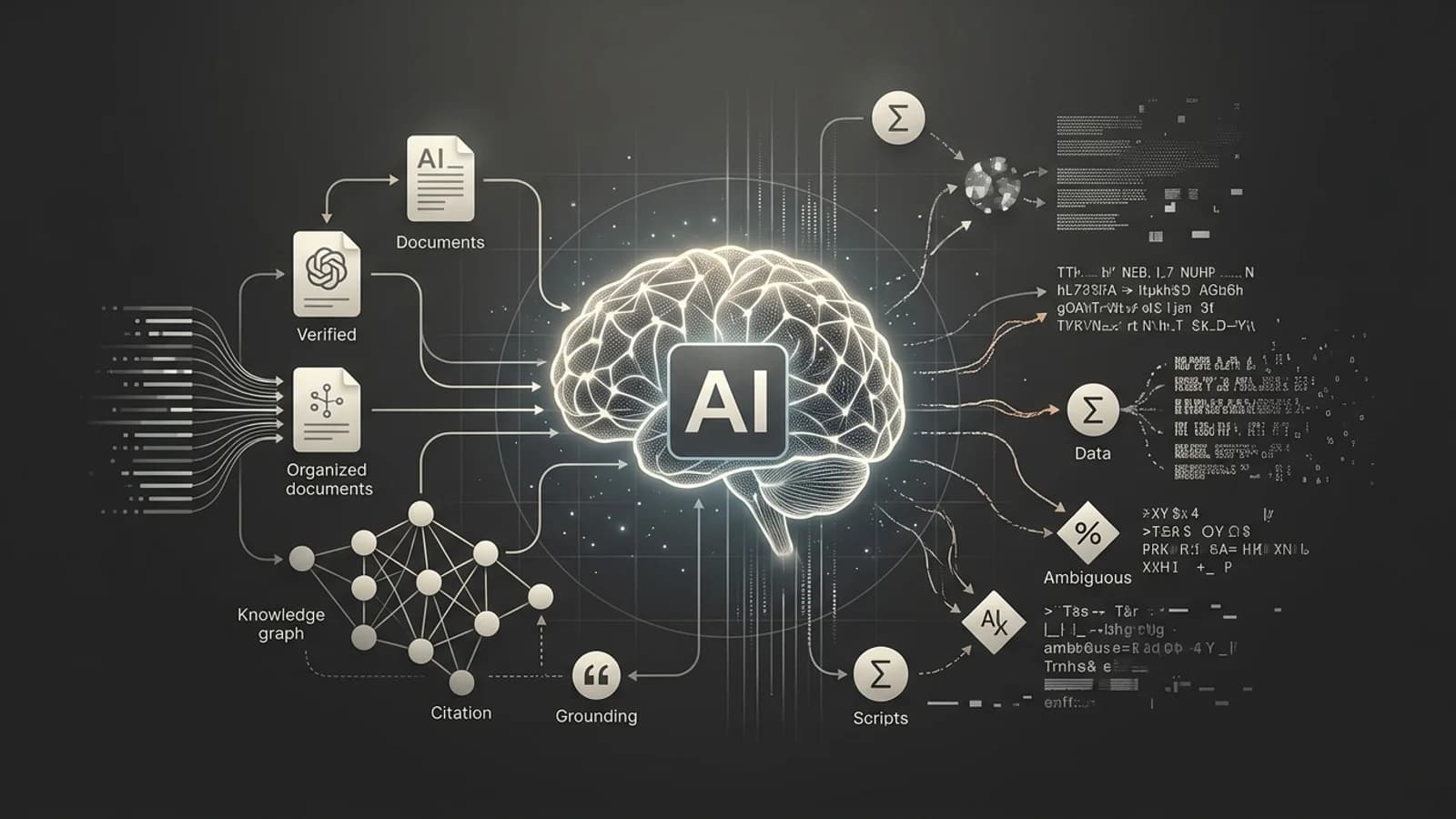
AI Hallucinations: Causes and Solutions
Generative AI
AI hallucinations are instances where an artificial intelligence system generates information that appears plausible, confident, or well-structured but is inaccurate, misleading, or entirely unsupported by reliable evidence. The term is commonly associated with generative AI systems, particularly large language models, which can produce fluent responses even when the underlying information is incomplete or incorrect.
Hallucinations can take many forms. An AI model may invent facts, cite nonexistent sources, generate incorrect technical explanations, misinterpret a user's question, or present outdated information as current. Because these responses can sound authoritative, identifying an AI hallucination is not always obvious without verifying the generated content against trustworthy sources.
AI hallucinations are not simply random errors. They are closely connected to how modern AI models are trained and how they generate responses. Large language models are designed to predict and produce likely sequences of words based on patterns learned from large datasets. As a result, a model can generate a convincing answer even when it does not have sufficient evidence to support that answer.
Understanding hallucinations is therefore essential for anyone working with generative AI. Developers, businesses, researchers, and everyday users need to recognize why these errors occur, how they affect AI applications, and which techniques can reduce their frequency and impact.
In simple terms: an AI hallucination occurs when an AI system produces an answer that sounds correct but does not accurately reflect the available facts, evidence, or underlying reality.
Generative AI
AI hallucinations occur because generative AI models are fundamentally designed to generate probable outputs rather than independently verify the truth of every statement they produce. Large language models learn patterns from enormous collections of text and use those patterns to predict what information should come next. When the model encounters incomplete, ambiguous, or unfamiliar information, it may generate an answer that is statistically plausible without being factually correct.
Another important factor is the quality and coverage of the data used during training. If training data contains inaccuracies, contradictions, outdated information, or gaps, the model can learn patterns that later contribute to incorrect responses. Even high-quality training datasets cannot contain every possible fact or provide reliable information about events that occurred after the model's knowledge was established.
The way a user formulates a prompt can also influence hallucinations. Vague questions, missing context, leading assumptions, and highly specific requests can make it difficult for a model to determine what information is actually required. Instead of refusing to answer, some systems may attempt to construct a complete response from the patterns available to them.
Hallucinations can become even more likely when a model is asked about obscure subjects, nonexistent entities, specialized technical details, or information that requires access to current external sources. Without appropriate grounding mechanisms, the model may fill these information gaps with generated content that appears coherent but cannot be reliably supported.
Key idea: AI models do not automatically distinguish every generated statement as true or false. They generate responses from learned patterns, which means insufficient context, imperfect data, ambiguous prompts, and missing information can all increase the risk of hallucination.
Generative AI
AI hallucinations do not come from a single technical problem. They can emerge from several interconnected factors, including limitations in model training, incomplete information, probabilistic text generation, ambiguous prompts, outdated knowledge, and the absence of reliable external verification. Understanding these causes is important because effective mitigation begins with identifying why a model is likely to generate unsupported information in the first place.
Modern generative AI systems are extremely capable at recognizing patterns and producing natural language, but fluency should not be confused with factual reliability. A model can generate a response that is grammatically correct, logically structured, and highly convincing while still containing incorrect information. The following factors represent some of the most important causes behind this behavior.
| Cause | What Happens | Hallucination Risk |
|---|---|---|
| Probabilistic Generation | The model predicts likely sequences of tokens based on learned patterns rather than independently verifying every statement against a source of truth. | High when the requested information is uncertain or poorly represented in the model's learned patterns. |
| Incomplete Training Data | The model may not have encountered enough reliable examples about a specific person, event, technical subject, or specialized domain. | Higher for niche, obscure, or poorly documented topics. |
| Outdated Knowledge | A model may rely on information from its training period when the question requires current facts, recent developments, prices, regulations, or newly released technologies. | High for time-sensitive information without live data access. |
| Ambiguous Prompts | A prompt with insufficient context can leave multiple possible interpretations, causing the model to make assumptions about the user's intended meaning. | Moderate to high depending on the complexity of the request. |
| Missing External Context | Without access to documents, databases, APIs, search systems, or other trusted sources, the model may attempt to answer using only its internal representations. | High for questions that depend on private, current, or domain-specific information. |
| Conflicting Information | When training material contains contradictory claims, the model may combine patterns from different sources into an answer that does not accurately represent either one. | Moderate to high, particularly in controversial or rapidly changing subjects. |
In real-world AI applications, hallucinations are often the result of multiple factors occurring simultaneously rather than a single failure. For example, a user may ask a vague question about a recently released technology. If the model has limited knowledge of that technology, lacks access to current information, and is not instructed to verify its claims, several sources of uncertainty are introduced at the same time.
This is why simply telling an AI model to "be accurate" is not always an effective solution. Reducing hallucinations usually requires improvements at multiple levels, including prompt design, retrieval of trusted information, grounding, model configuration, validation, and human oversight where the consequences of an incorrect answer are significant.
The architecture, training process, optimization objectives, and learned representations of a model influence how it generates information. A language model is optimized primarily to produce useful and probable sequences of tokens, not to function as a universal database with guaranteed factual verification.
Training and retrieval data can contain missing information, inconsistencies, outdated material, or low-quality sources. When unreliable patterns enter the information pipeline, they can influence the quality of the generated response.
Poorly defined prompts can create uncertainty about the task, constraints, audience, or required evidence. Clear instructions, relevant context, and explicit source requirements can significantly reduce unnecessary assumptions.
Production AI systems often depend on retrieval systems, APIs, databases, tools, and application logic. Errors can occur when these external components provide incomplete, irrelevant, stale, or incorrectly processed information to the model.
One of the most important concepts for understanding hallucinations is that language models generate text through probabilistic prediction. At a simplified level, the model evaluates possible next tokens and assigns probabilities based on the context it has received. It then generates a sequence that appears appropriate for the request.
This mechanism is extremely effective for generating natural language, but probability is not the same thing as truth. A statement can be highly plausible from a linguistic perspective while being completely unsupported by evidence. This distinction explains why an AI response can sound authoritative even when it contains fabricated names, incorrect numbers, nonexistent references, or false explanations.
Key takeaway: hallucinations are best understood as a reliability problem across the entire AI information pipeline. Model behavior, data quality, prompts, external context, and verification mechanisms can all influence whether an AI-generated response is trustworthy.
Generative AI
AI hallucinations are not limited to one particular type of error. A generative AI system can fabricate facts, distort existing information, create nonexistent references, misunderstand context, or produce technically incorrect reasoning while presenting the result with a high degree of confidence. The form of hallucination often depends on the task, the available context, the model's capabilities, and whether the system has access to reliable external information.
Recognizing the different types of hallucinations is important because each category can require a different mitigation strategy. A fabricated citation, for example, may require source verification, while an incorrect answer caused by ambiguous context may be better addressed through improved prompting and additional context.
Type 01
The model generates statements that conflict with established facts or presents invented information as factual. This can include incorrect dates, names, statistics, events, technical specifications, or historical details.
Example: An AI system provides an incorrect publication date for a book while presenting the date with confidence.
Type 02
The model creates information that does not actually exist. It may invent people, companies, products, research papers, legal cases, websites, statistics, or events when attempting to provide a complete response.
Example: A model creates a convincing but nonexistent research paper and attributes it to a real researcher.
Type 03
Citation hallucinations occur when an AI system provides references that appear legitimate but cannot be verified. The citation may contain an invented title, author, publication, URL, DOI, page number, or other bibliographic detail.
Example: An AI-generated academic answer includes a citation to a paper that does not exist.
Type 04
Contextual hallucinations happen when the model misunderstands or incorrectly interprets the information provided in a conversation, document, or prompt. The response may contain individually plausible statements but fail to accurately reflect the supplied context.
Example: A model summarizes a document but attributes a statement from one section to a completely different person mentioned elsewhere.
Type 05
A logical hallucination occurs when an AI system produces reasoning that appears coherent but contains an invalid conclusion, unsupported assumption, or contradiction. The language may be convincing even though the reasoning process does not correctly support the final answer.
Example: A model follows several calculation steps correctly but makes an incorrect inference when interpreting the final result.
Type 06
These occur when a model incorrectly interprets the user's instructions or invents requirements that were never provided. The generated output may appear polished while failing to follow the actual task constraints.
Example: A user requests a concise summary, but the model introduces unrelated information and changes the requested output format.
Although these categories can overlap, separating them makes it easier to evaluate AI reliability systematically. In a production environment, teams should consider not only whether an answer is wrong, but also what kind of failure occurred and which part of the AI pipeline contributed to it.
| Hallucination Type | Typical Failure | Common Risk | Useful Mitigation |
|---|---|---|---|
| Factual | Incorrect facts or unsupported claims | Misleading decisions and incorrect information | Retrieval, source verification, and factual evaluation |
| Fabricated | Nonexistent people, events, products, or information | False claims presented as real | Grounding and external verification |
| Citation | Invalid or nonexistent references | Unreliable research and misleading evidence | Automated and manual citation checking |
| Contextual | Misinterpretation of supplied information | Incorrect summaries and responses | Better context management and retrieval |
| Logical | Invalid reasoning or unsupported conclusions | Incorrect analysis and decisions | Structured reasoning checks and evaluation |
| Instruction | Failure to correctly follow task requirements | Incorrect or unusable output | Clear prompts, constraints, and output validation |
Identifying the category of a hallucination helps developers move beyond simply detecting that an answer is wrong. For example, if a chatbot repeatedly invents information about a company's internal policies, the underlying issue may be the absence of reliable retrieval data rather than the language model itself. Adding authoritative documents through a retrieval-augmented generation pipeline may therefore be more effective than simply changing the prompt.
Similarly, if an AI application generates incorrect citations, the system should validate references against trusted databases or source documents. If the primary problem is misunderstanding user instructions, the solution may instead involve clearer prompts, structured inputs, explicit output schemas, and automated validation.
Key takeaway: AI hallucinations can appear as factual errors, fabricated information, invalid citations, contextual misunderstandings, logical mistakes, or instruction failures. Correctly identifying the failure type makes it much easier to select the right strategy for reducing hallucinations and improving the reliability of an AI system.
AI Reliability
AI hallucinations are one of the most important reliability challenges in modern generative AI. As language models become increasingly capable of producing fluent, detailed, and context-aware responses, the ability to distinguish generated information from verified information becomes even more important. Hallucinations can originate from probabilistic generation, incomplete or outdated knowledge, ambiguous instructions, insufficient context, and weaknesses in the systems surrounding the model.
Reducing hallucinations therefore requires more than simply asking an AI model to provide accurate answers. Professional AI systems can combine techniques such as retrieval-augmented generation, authoritative knowledge sources, structured prompting, output validation, citation verification, model evaluation, and human oversight. The appropriate approach depends on the application's purpose, the quality of available data, and the potential consequences of an incorrect response.
For developers and AI engineers, the key principle is to treat factual reliability as a system-level responsibility. A language model should not automatically be considered a source of truth. Instead, important claims should be grounded in relevant information, evaluated against appropriate benchmarks, and verified whenever accuracy is critical.
Final perspective: the goal is not necessarily to eliminate every possible hallucination, but to design AI systems that can recognize uncertainty, use reliable information, verify important claims, and minimize the consequences of incorrect generation.

Editor in Chief
Software engineer and full-stack developer building modern digital experiences, products, and ideas.
sudaisazlan.comReady to do everything better? Get daily tips, tricks, and tech guides from our expert team.
By clicking Sign Up, you confirm you are 16+ and agree to our Terms of Service and Privacy Policy.
Have fun. Be respectful. Feel free to criticize ideas, but not people.