01
Reasoning Model
The reasoning model interprets the user's objective, analyzes available context, generates decisions, and determines which action should be taken next.
Primary responsibility
Understand, reason, plan, and decide.

Explore the evolution of AI agents that perform tasks autonomously, enhancing productivity across various sectors.
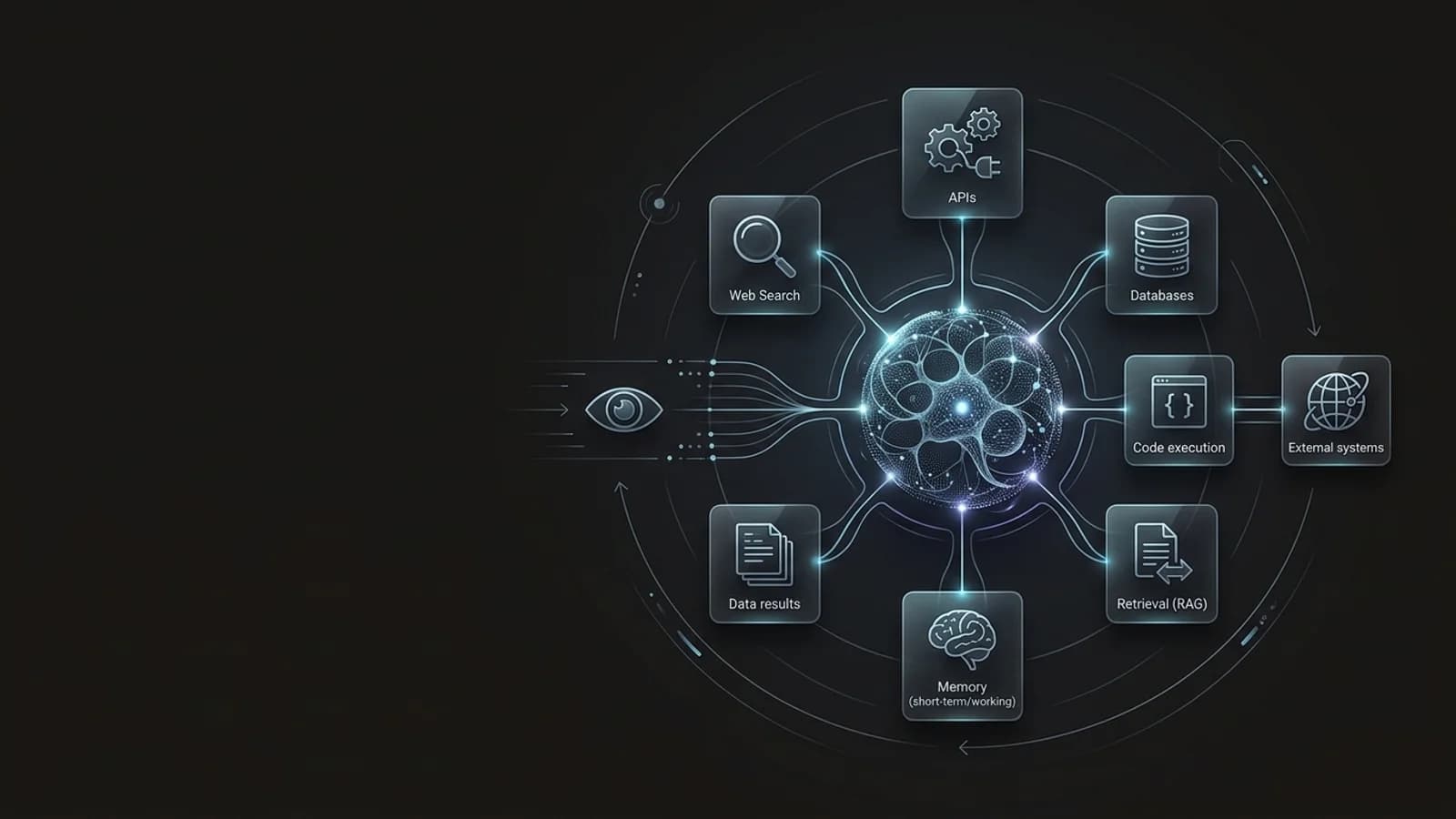
The Rise of AI Agents
Generative AI & Agentic AI
Artificial intelligence is entering a new phase in which AI systems are moving beyond simply generating responses to actively performing tasks. This evolution has given rise to AI agents: intelligent software systems designed to understand objectives, reason about problems, use tools, interact with external systems, and take actions with varying levels of autonomy.
Traditional AI applications are generally designed to respond to a specific input, such as classifying an image, answering a question, or generating text. AI agents take a broader approach. Instead of producing only a single response, an agent can break a goal into smaller tasks, determine what information it needs, select appropriate tools, execute actions, evaluate results, and continue working until the objective is completed or human intervention is required.
Advances in large language models, tool integration, memory systems, retrieval-augmented generation, planning techniques, and agent orchestration frameworks have accelerated this transformation. As these technologies become more capable, AI agents are increasingly being explored for software development, research, customer support, business automation, data analysis, cybersecurity, robotics, and other complex workflows.
In simple terms: a traditional AI system may answer a question, while an AI agent can understand a goal, decide what needs to be done, use available tools, and take multiple actions to accomplish that goal.
AI & Agentic Systems
AI agents are intelligent software systems that can pursue a defined goal by understanding information, reasoning about possible actions, using external tools, and executing multiple steps with limited human intervention. Rather than operating only as question-and-answer systems, agents are designed to work through a problem and take action within a specific environment.
At the center of an AI agent is a decision-making process. The agent receives a goal or task, analyzes the available information, determines what should happen next, performs an action, observes the result, and then decides whether another action is necessary. This iterative process allows an agent to handle workflows that may require several connected steps instead of producing a single output.
Modern AI agents are often powered by large language models (LLMs), but an LLM alone is not necessarily an agent. The language model provides reasoning and language capabilities, while the surrounding agent system provides tools, memory, instructions, state management, planning, and mechanisms for interacting with external environments.
The agent collects and interprets information from users, documents, APIs, databases, sensors, websites, or other available sources.
The agent analyzes the current situation, determines what needs to be accomplished, and selects an appropriate course of action.
The agent interacts with tools and external systems to perform tasks, retrieve information, modify data, or trigger real-world workflows.
Understanding the shift from response generation to goal-oriented execution.
| Capability | Traditional AI | AI Agent |
|---|---|---|
| Primary role | Produces predictions, classifications, or responses | Pursues goals and performs multi-step tasks |
| Decision-making | Usually follows a predefined workflow | Can dynamically determine the next action |
| Tool usage | Often limited or explicitly programmed | Can select and invoke tools according to the task |
| Memory | Often limited to the current interaction | Can maintain short-term or persistent task context |
| Autonomy | Generally low | Can operate with varying levels of autonomy |
| Workflow | Input → model → output | Goal → reasoning → action → observation → next action |
A key characteristic of AI agents is their ability to operate through an iterative loop. Instead of generating one response and stopping, an agent can evaluate the current state, choose an action, observe the result, and use that new information to determine what should happen next.
01 · Goal
Understand the objective that needs to be completed.
02 · Reason
Determine the information, strategy, and next action required.
03 · Act
Use an available tool, API, database, or other capability.
04 · Observe
Analyze the result returned by the action.
05 · Repeat
Continue the cycle until the objective is completed or stopped.
A large language model can generate text and reason over information, but an agent requires additional infrastructure to turn those capabilities into an operational system. The model acts as the reasoning engine, while tools, memory, instructions, state, and orchestration allow the system to interact with its environment.
Provides language understanding, generation, and reasoning capabilities.
Allow the agent to search, calculate, retrieve data, call APIs, or interact with external systems.
Preserve relevant context and information across the agent's workflow or interactions.
Coordinates reasoning, tool calls, decisions, and transitions between different stages of a workflow.
Key Insight
The defining shift behind AI agents is not simply better text generation. It is the ability to connect intelligence with action. An agent can reason about what should happen next and then interact with tools or systems to make that decision operational.
Traditional AI
Input → Processing → Response
AI Agent
Goal → Reason → Tool → Observe → Reason → Act
Important distinction: an AI agent should not be defined simply as an application that uses an LLM. The defining characteristic is its ability to use reasoning and available capabilities to pursue an objective through a sequence of actions and observations.
Agent Architecture
AI agents work by combining a reasoning model with instructions, tools, memory, environmental information, and an execution loop. Instead of treating every request as a single input-and-output operation, an agent continuously evaluates the current state of a task and determines what action should be taken next.
When a user provides a goal, the agent first interprets what the user is trying to accomplish. It then identifies the information available to it, determines whether additional information is required, selects the appropriate tools, executes an action, and evaluates the resulting information. If the objective has not yet been achieved, the agent can continue through additional reasoning and action cycles.
This architecture allows AI agents to handle tasks that are difficult to solve through a single model response. A research agent, for example, may search multiple sources, extract relevant information, compare findings, identify missing evidence, perform additional searches, and finally produce a structured report.
Agent Workflow
An agent can repeatedly move through these stages rather than stopping after generating its first response.
The agent receives an objective from a user, application, event, or another system and determines what outcome is expected.
The agent examines the available conversation, instructions, retrieved information, memory, environment state, and other relevant context.
The reasoning system determines what needs to happen and may divide a complex objective into smaller, manageable steps.
The agent chooses an appropriate capability such as web search, database access, code execution, an API, calculator, or business system.
The agent receives the result of its action and determines whether the information is sufficient, useful, correct, or requires another action.
When the required conditions are satisfied, the agent produces the final result or hands the completed outcome back to the user or calling system.
Although implementations differ, most capable agent systems can be understood through a collection of core components that work together. Each component contributes a different capability to the overall decision-making system.
| Component | Purpose | Example |
|---|---|---|
| Reasoning Model | Interprets information and determines possible actions. | Large language model or specialized reasoning model |
| Instructions | Defines the agent's role, behavior, constraints, and objectives. | System instructions and task policies |
| Tools | Extends the agent beyond its built-in knowledge and reasoning. | Search, APIs, databases, calculators, code execution |
| Memory | Preserves relevant information across interactions or tasks. | Conversation state or vector database |
| Retrieval | Provides relevant external information when the model needs it. | RAG system or document retrieval |
| Orchestration | Coordinates states, actions, tools, and transitions. | Agent workflow or graph-based orchestration |
| Environment | Represents the systems and information the agent can interact with. | Websites, applications, databases, or physical devices |
Execution Cycle
The most important architectural idea behind many AI agents is the iterative loop connecting reasoning with action. The agent does not necessarily know every step before execution begins. Instead, it can use the outcome of one action to determine what should happen next.
Step 01
Examine the current task, context, and available information.
Step 02
Determine what information or action is needed next.
Step 03
Invoke a tool or perform an available operation.
Step 04
Inspect the result and compare it with the desired objective.
Step 05
Repeat the cycle when more work is required or finish when the goal has been satisfied.
Example
Imagine a user asks an AI agent to prepare a report about the latest developments in a specific technology. The agent does not necessarily need to generate the report immediately. It can first identify the research requirements, search relevant sources, collect information, compare the findings, identify gaps, and then construct the final report.
Understand the requested research objective.
Determine which information and sources are required.
Search and retrieve relevant information.
Evaluate the collected information and identify missing evidence.
Produce and structure the final research output.
Why It Matters
The importance of AI agents comes from connecting intelligence with execution. A model can reason about what should happen, but an agent can connect that reasoning to tools and systems that allow the desired outcome to be pursued.
The basic progression can be viewed as:
Key takeaway: an AI agent is best understood as a goal-oriented system that connects a reasoning engine with tools, memory, context, and an execution loop. Its ability to repeatedly observe, reason, act, and evaluate results is what enables it to move from simply generating information toward completing meaningful tasks.
Agent Architecture
An AI agent is not a single technology. It is a coordinated system made up of multiple components that work together to transform a user goal into intelligent actions. While implementations can vary significantly, modern agent architectures commonly combine a reasoning model, instructions, memory, tools, retrieval systems, state management, and an orchestration layer.
Each component has a specific responsibility. The reasoning model provides intelligence, tools connect the agent to external capabilities, memory preserves useful context, retrieval provides access to external knowledge, and orchestration coordinates the overall workflow. Together, these components allow an agent to operate as a goal-oriented system rather than simply as a text-generation interface.
The reasoning model interprets the user's objective, analyzes available context, generates decisions, and determines which action should be taken next.
Primary responsibility
Understand, reason, plan, and decide.
Instructions define the agent's role, objectives, behavioral rules, available capabilities, safety boundaries, and the conditions under which it should complete or stop a task.
Primary responsibility
Define behavior and constraints.
Tools extend an agent's capabilities beyond what its model can do internally. They allow it to interact with external services, retrieve information, perform calculations, execute code, or modify data.
Primary responsibility
Turn decisions into actions.
Memory allows an agent to preserve useful information across a workflow or multiple interactions. Depending on the architecture, this can include conversation history, user preferences, previous actions, or stored knowledge.
Primary responsibility
Preserve relevant context.
Retrieval systems provide agents with relevant information from external knowledge sources such as documents, databases, websites, enterprise systems, or vector databases.
Primary responsibility
Provide relevant external knowledge.
The orchestration layer coordinates the agent's state, reasoning, tool calls, decisions, retries, and transitions between different stages of a workflow.
Primary responsibility
Coordinate the entire workflow.
Architecture Overview
The following model shows how the major components contribute to an agent's ability to understand a goal and execute a task.
| Layer | Function | Typical Technologies | Why It Matters |
|---|---|---|---|
| Reasoning | Understands context and determines decisions. | LLMs and reasoning models | Provides the agent's decision-making capability. |
| Memory | Stores useful context and previous information. | Databases, state stores, vector databases | Enables continuity across interactions and workflows. |
| Retrieval | Finds relevant information from external sources. | RAG pipelines, search systems, knowledge bases | Gives the agent access to information beyond its model context. |
| Tools | Performs external operations. | APIs, search, code execution, databases | Allows the agent to interact with the outside world. |
| State | Tracks what has happened during execution. | State objects, workflow stores | Keeps multi-step execution coherent. |
| Orchestration | Controls the sequence of operations. | Agent frameworks and workflow graphs | Turns individual capabilities into a coordinated system. |
Capability Layers
The reasoning model interprets language, analyzes information, generates plans, and makes decisions.
Retrieval and memory systems provide the information and context required for informed decisions.
Tools and APIs allow the agent to interact with external applications, services, databases, and environments.
The orchestration layer manages state, controls execution, coordinates components, and determines how the workflow progresses.
Practical Example
Consider an AI agent responsible for helping a company analyze customer support requests. The user asks the agent to identify the most common issues reported during the previous month and prepare a summary for the support team.
Step 01 — Reasoning
The agent interprets the request and determines that it needs access to the company's support records.
Step 02 — Tool Selection
The agent selects a database or analytics tool capable of retrieving the relevant support records.
Step 03 — Retrieval
Relevant records are retrieved and supplied to the agent for further analysis.
Step 04 — Analysis
The reasoning model identifies patterns, groups similar issues, and determines which problems occur most frequently.
Step 05 — Evaluation
The agent evaluates whether the available information is sufficient to answer the original request.
Step 06 — Final Output
The agent creates a structured summary containing the major support issues, their frequency, and useful observations for the team.
Key takeaway: the intelligence of an AI agent comes from the interaction between its components. A powerful model alone does not create a complete agent. Reliable agentic systems require the right combination of reasoning, knowledge, memory, tools, state, orchestration, and well-defined constraints.
Agent Intelligence
Reasoning and planning are central capabilities of an AI agent. When an agent receives a complex objective, it must determine what the objective means, identify the actions required to achieve it, decide which tools or sources should be used, and continuously evaluate whether its current approach is moving toward the desired outcome.
Unlike a fixed automation workflow, an agent can often make decisions dynamically. The exact sequence of actions does not always have to be hard-coded in advance. Instead, the agent can use the information available at each stage to determine what should happen next.
This does not mean that an AI agent possesses human-like reasoning in every situation. Agentic systems still depend on the capabilities and limitations of their underlying models, tools, instructions, and environment. However, when these components are properly designed, an agent can solve multi-step problems by repeatedly combining reasoning with action.
The Planning Process
A complex request can be transformed into smaller actions that are easier to execute, evaluate, and revise. Depending on the task, an agent may create an explicit plan or determine each next step dynamically.
Determine the desired outcome, constraints, available resources, and success criteria.
Divide a complex objective into smaller tasks that can be completed independently or sequentially.
Determine which tools, information sources, APIs, or operations are appropriate for each step.
Inspect the results and modify the plan when new information or unexpected conditions appear.
Planning Strategies
| Strategy | How It Works | Best Suited For | Main Characteristic |
|---|---|---|---|
| Sequential Planning | The agent creates a sequence of steps and executes them in order. | Structured multi-step workflows | Predictable execution |
| Dynamic Planning | The agent determines the next action based on the current result and context. | Uncertain or changing environments | Adaptive execution |
| Hierarchical Planning | A high-level objective is divided into larger tasks and then smaller executable subtasks. | Large and complex objectives | Multi-level decomposition |
| Iterative Planning | The agent repeatedly revises its approach using feedback from previous actions. | Research, coding, analysis, optimization | Continuous refinement |
Decision Making
Once an agent understands a task, it needs to determine what action will provide the most useful progress. The decision may involve selecting a tool, retrieving information, asking for clarification, executing code, updating a record, or producing a final response.
What do I know?
Identify the information already available in the current context and memory.
What am I missing?
Identify missing information that could prevent the task from being completed accurately.
Which action helps most?
Select the available operation that is most relevant to the current state of the task.
Feedback
An agent can use the result of an action as new context for its next decision. This feedback loop is especially important when the agent cannot predict the complete execution path in advance.
Action
Search for relevant information.
Result
The returned information is incomplete.
Adaptation
The agent identifies the missing information and performs another search.
Real-World Example
Consider a software development agent that receives the request: "Add authentication to this application and make sure the existing tests still pass."
Understand
Examine the existing application structure, dependencies, configuration, and authentication-related code.
Plan
Determine which files, routes, models, middleware, and tests need to be modified.
Act
Use coding and file-system tools to implement the required changes.
Verify
Run tests, inspect failures, revise the implementation, and repeat until the desired result is achieved.
Fixed Automation
A traditional automation system typically follows a predefined sequence. If the workflow changes or an unexpected condition occurs, additional rules may need to be programmed to handle that situation.
Example
Trigger → Step A → Step B → Step C → Finish
Agentic System
An AI agent can evaluate the current state and choose among multiple possible actions. When the environment changes, it can potentially revise its plan rather than following only one predetermined path.
Example
Goal → Reason → Choose → Act → Observe → Re-plan
Engineering Perspective
Planning enables an agent to handle objectives that require multiple dependent operations.
Agents can adjust their next action when new information or unexpected results appear.
Verification and feedback loops can help detect failures before the final result is returned.
Key takeaway: planning gives AI agents a mechanism for turning broad objectives into actionable workflows. The most capable systems combine planning with tool use, memory, retrieval, and feedback so they can adapt their behavior as a task progresses rather than relying entirely on a fixed sequence of instructions.
References & Further Reading
AI agents combine large language models with reasoning, planning, tool use, memory, retrieval, and orchestration. Because the field is evolving rapidly, readers should consult primary research papers, official technical documentation, and engineering resources when exploring agent architectures and implementations in greater depth.
The following references provide a strong foundation for understanding the concepts discussed throughout this article, including autonomous agents, tool use, reasoning, planning, retrieval-augmented generation, and agent-oriented system design.
Reasoning + tool interaction
ReAct introduced a framework that interleaves reasoning traces with actions, allowing language models to interact with external environments and use observations to guide subsequent decisions.
Read the research paperMemory and autonomous behavior
This research explores simulated agents that maintain memories, retrieve relevant experiences, reflect on information, and use those memories to influence future behavior.
Read the research paperLanguage models using tools
Toolformer investigates how language models can learn to decide when external tools are useful and how to incorporate the resulting tool outputs into their generation process.
Read the research paperRetrieval and external knowledge
Retrieval-augmented generation provides a foundation for systems that combine language-model generation with information retrieved from external knowledge sources.
Read the research paper| Resource | Focus | Why It Matters |
|---|---|---|
| ReAct | Reasoning and acting | Demonstrates how reasoning and environment interaction can be combined in an agent workflow. |
| Generative Agents | Memory and reflection | Explores how memory and reflection can support more persistent agent behavior. |
| Toolformer | Tool use | Provides research into language models interacting with external tools. |
| RAG | External knowledge | Establishes an important pattern for grounding model responses with retrieved information. |
Editorial note: AI-agent architectures are still evolving. Research papers provide the theoretical foundation, while production systems may combine these ideas with model-specific tool calling, retrieval systems, workflow engines, observability, permissions, and human-in-the-loop controls.
Further Reading
To continue learning, explore current research on autonomous agents, planning, reasoning, memory architectures, multi-agent systems, retrieval-augmented generation, function calling, and reliable agent orchestration. Studying both research literature and real-world implementations provides a stronger understanding of how agentic systems are designed and deployed.

Editor in Chief
Software engineer and full-stack developer building modern digital experiences, products, and ideas.
sudaisazlan.comReady to do everything better? Get daily tips, tricks, and tech guides from our expert team.
By clicking Sign Up, you confirm you are 16+ and agree to our Terms of Service and Privacy Policy.
Have fun. Be respectful. Feel free to criticize ideas, but not people.