01
Perception
The agent gathers information from user requests, documents, APIs, databases, sensors, or other external sources before making decisions.

Explore the innovative architecture of Agentic AI systems, which enable intelligent decision-making and autonomy.
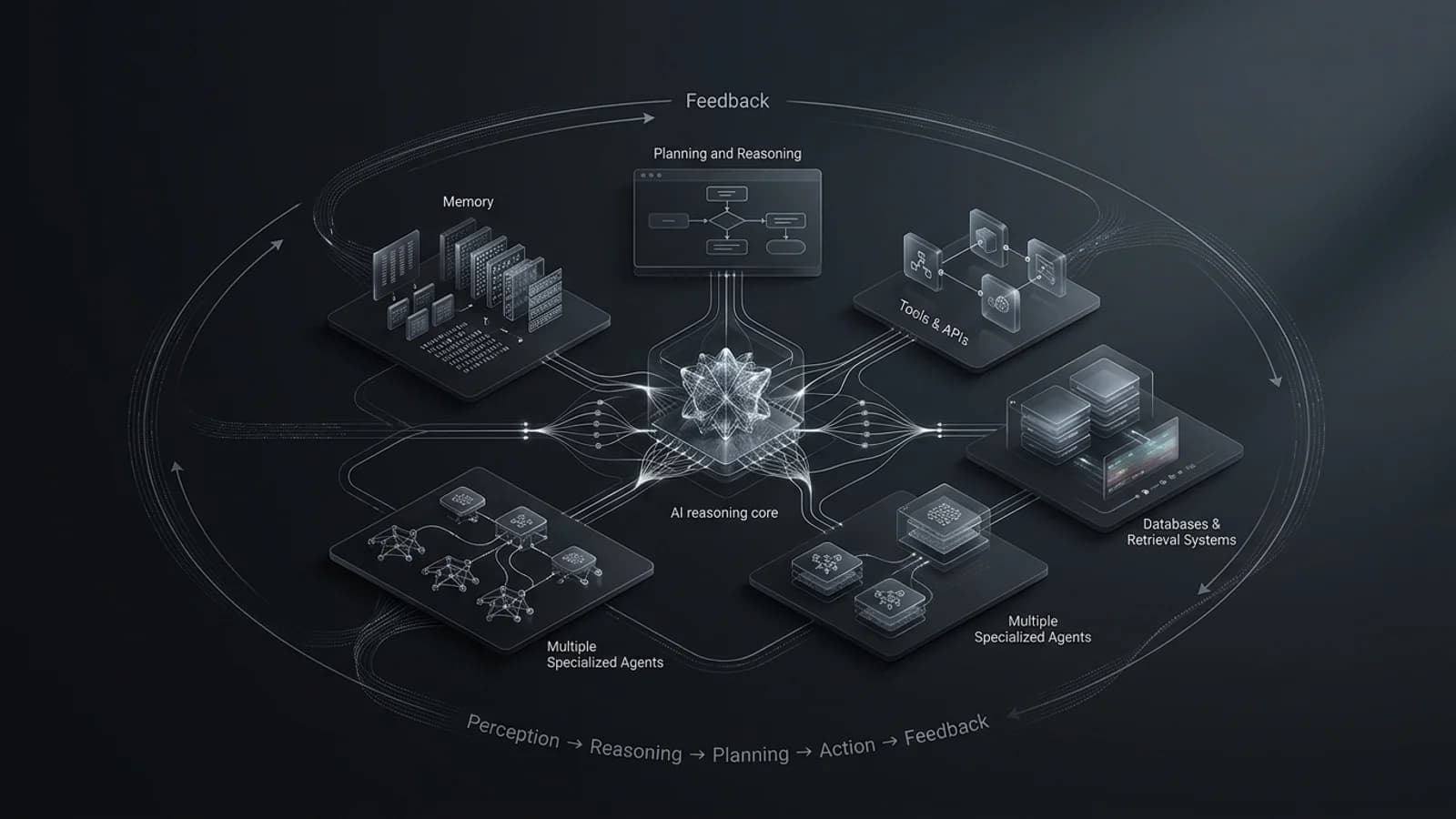
The Architecture of Agentic AI
Agentic AI
The architecture of Agentic AI defines how intelligent systems perceive information, reason about objectives, make decisions, use tools, maintain context, and execute actions with varying degrees of autonomy. Unlike conventional AI applications that typically follow a predetermined request-and-response pattern, agentic systems are designed around an ongoing decision-making loop in which the system can determine what should happen next based on its current state, available information, and desired outcome.
A well-designed agentic architecture is therefore more than simply placing a large language model at the center of an application. It combines multiple components—including reasoning models, memory, planning, perception, tool interfaces, retrieval systems, state management, and execution mechanisms—to create a system capable of handling multi-step tasks. These components work together so an agent can interpret a goal, develop an approach, interact with external systems, evaluate results, and adjust its behavior when circumstances change.
At a high level, an Agentic AI system can be understood as a continuous cycle: perceive, reason, plan, act, and evaluate. The system receives information from users, databases, APIs, sensors, or other agents; reasons over that information; selects an appropriate action; executes it through a tool or external system; and then uses the resulting feedback to determine the next step.
In simple terms: the architecture of Agentic AI is the framework that connects reasoning, memory, planning, tools, and execution so an AI system can move beyond generating responses and actively work toward completing a goal.
Agentic AI Architecture
An Agentic AI system is built from several interconnected components, each responsible for a specific part of the agent's decision-making and execution process. The exact architecture varies according to the application, but most production-grade systems contain a combination of reasoning, memory, planning, tool use, state management, and evaluation capabilities.
Understanding these components is essential because an agent's intelligence does not come from the language model alone. The surrounding architecture determines what information the agent can access, what actions it can take, how it remembers previous interactions, and how effectively it can recover from unsuccessful actions.
| Component | Primary Role | Typical Technologies |
|---|---|---|
| Reasoning Engine | Interprets goals, evaluates information, and determines what should happen next. | LLMs, reasoning models |
| Memory | Stores relevant short-term and long-term context for future decisions. | Databases, vector stores, conversation state |
| Planning Layer | Breaks complex objectives into smaller steps and determines an execution strategy. | Task planners, workflows, agent graphs |
| Tool Layer | Gives the agent access to external capabilities and information. | APIs, search, code execution, databases |
| State Management | Tracks the current task, intermediate results, decisions, and execution progress. | State graphs, application state, checkpoints |
| Evaluation & Feedback | Checks whether actions and results satisfy the intended objective. | Validators, evaluators, human feedback |
The agent gathers information from user requests, documents, APIs, databases, sensors, or other external sources before making decisions.
The reasoning layer interprets the available context, identifies constraints, and determines the most appropriate next action.
Planning converts a high-level objective into a sequence of manageable actions that the agent can execute and revise when necessary.
Memory allows the system to preserve useful information across steps, sessions, or tasks instead of treating every interaction as isolated.
Tools extend the agent beyond language generation by allowing it to search information, call APIs, query databases, execute code, or interact with external services.
Evaluation determines whether an action produced a useful result and whether the agent should continue, revise its strategy, or stop.
Input
The agent receives an objective and the information required to understand the task.
Intelligence
The system evaluates the situation, creates a plan, and selects the appropriate tools.
Execution
The agent performs actions, observes the results, and determines the next step.
Architecture principle: an effective agentic system should separate reasoning, state, tools, memory, and execution responsibilities while maintaining a reliable feedback loop between them. This makes the system easier to evaluate, debug, scale, and control in production environments.
Agentic AI Architecture
A production-grade Agentic AI system is best understood as a collection of coordinated layers rather than a single model or application component. Each layer has a distinct responsibility, while communication between the layers enables the system to transform a high-level objective into concrete actions and measurable results.
This layered approach is important because intelligent agents operate in environments that are often dynamic, incomplete, and unpredictable. An agent may need to retrieve information, decide which tool to use, execute an action, inspect the result, update its state, and revise its plan. Separating these responsibilities creates a more reliable architecture and makes individual components easier to improve without redesigning the entire system.
The interaction layer provides the entry point through which users or external applications communicate with the agent. It can accept natural-language requests, structured inputs, documents, voice, images, or events generated by another system.
Its responsibility is to normalize incoming information and pass meaningful context to the agent rather than allowing the reasoning layer to handle every interface-specific concern.
Before an agent can make a useful decision, it must understand the information available to it. The perception and context layer collects relevant signals from conversations, files, databases, retrieval systems, APIs, sensors, and application state.
This layer is especially important for agents operating with external knowledge. Retrieval mechanisms can identify relevant information and provide it to the reasoning model at the moment it is needed, reducing dependence on information contained solely within the model's parameters.
Typical responsibility
Collect, filter, retrieve, and organize the information required for the agent to make its next decision.
The reasoning layer is responsible for interpreting the objective, examining the available context, considering constraints, and determining the next appropriate step. Large language models or specialized reasoning models commonly perform this function.
Importantly, reasoning should not be treated as an isolated generation step. In an agentic workflow, the model may reason, select a tool, observe the tool's result, reconsider the situation, and then make another decision. This creates an iterative decision-making process rather than a single prediction.
Determines what the user or system is ultimately trying to accomplish.
Selects an appropriate next action based on available context and constraints.
Complex objectives frequently require multiple actions. The planning and orchestration layer determines how those actions should be organized and executed. A planner may decompose a large task into smaller subtasks, establish dependencies, select specialized agents, or dynamically revise the sequence when new information becomes available.
Orchestration is particularly important in multi-agent systems, where different agents may specialize in research, coding, analysis, verification, or communication. The orchestrator coordinates these capabilities and ensures that information moves correctly between stages.
| Planning Function | Purpose |
|---|---|
| Task decomposition | Breaks a complex objective into smaller executable tasks. |
| Dependency management | Determines which actions must occur before others. |
| Agent routing | Directs specialized tasks to the appropriate agent or tool. |
| Plan revision | Updates the strategy when execution produces unexpected results. |
Tools give an agent the ability to interact with systems outside the language model. Instead of merely describing what should be done, an agent can use an API, search engine, database, calculator, code execution environment, or business application to perform real operations.
A robust tool layer should provide clear interfaces, predictable inputs and outputs, authentication boundaries, validation, and appropriate permission controls. The model decides when a tool is useful, while the application layer remains responsible for enforcing what the agent is actually allowed to do.
Information tools
Retrieve current, domain-specific, or application-specific information from external sources.
Action tools
Perform controlled actions such as creating records, sending requests, updating systems, or executing workflows.
Memory and state allow an agent to maintain continuity throughout its execution. State represents what is currently happening in a task, while memory generally refers to information that can be retained and reused beyond an individual step or interaction.
Tracks the current conversation, intermediate results, tool outputs, active plan, and execution status.
Preserves useful information that may remain relevant across future interactions or tasks.
Key distinction: state helps an agent understand where it is in the current workflow, while memory helps it retain information that can be useful later.
Autonomous execution introduces the possibility of incorrect decisions, invalid tool calls, unexpected outputs, and unsafe actions. The evaluation and guardrail layer provides mechanisms for detecting these conditions before they propagate through the system.
Evaluation can occur after individual actions or across the completed workflow. Depending on the application, the system may validate structured outputs, verify retrieved information, inspect tool results, enforce permissions, require human approval, or compare the final result against predefined objectives.
Check whether outputs satisfy required formats and constraints.
Restrict actions that exceed defined permissions or policies.
Use results and observations to improve subsequent decisions.
Introduce approval checkpoints for sensitive or high-impact operations.
Architecture Flow
These layers work together as a continuous control loop. The agent does not necessarily execute every step in a fixed sequence; instead, the reasoning and orchestration layers can revisit earlier stages whenever new information changes the situation.
Interpret the objective and context.
Determine the steps required to reach the goal.
Select tools and execute the next action.
Inspect the result and update the current state.
Continue, revise, or terminate the workflow.
Engineering perspective: the strongest agentic architectures are not defined by how many components they contain. They are defined by how reliably those components cooperate, how clearly responsibilities are separated, and how effectively the system can observe, evaluate, and recover from its own actions.
Agentic AI Architecture
The defining characteristic of an agentic system is not simply its ability to generate text or call a tool. It is the ability to operate through a continuous control loop in which the system interprets a goal, determines an action, observes the outcome, and uses the new information to decide what should happen next.
This loop gives an AI agent a fundamentally different operating model from a conventional single-pass application. Instead of producing one response immediately after receiving an input, the agent can execute multiple intermediate steps and dynamically change its strategy as the environment provides new information.
Gather relevant information from the user, environment, memory, or external systems.
Interpret the current state, evaluate constraints, and determine the most useful next step.
Use a tool, execute a workflow, retrieve information, or perform another permitted operation.
Examine the result, update the state, and determine whether another action is necessary.
Step 01
An agent begins by collecting information relevant to its current objective. This may include a user's request, previous conversation history, retrieved documents, database records, API responses, files, application state, or real-world sensor data.
The objective is not to collect everything available. Effective architectures focus on providing the reasoning layer with the information necessary to make an informed decision.
A research agent may receive a question, retrieve relevant sources, inspect previous findings, and combine those signals into a current task context before deciding what to investigate next.
Step 02
Once the relevant context is available, the reasoning component determines what should happen next. It evaluates the objective, available information, previous actions, constraints, and available tools.
Depending on the task, the agent may decide to answer immediately, retrieve additional information, call a tool, create a subtask, ask for clarification, or revise an earlier assumption.
The reasoning layer should make decisions from explicit state and relevant context rather than relying on an uncontrolled sequence of model-generated actions.
Step 03
After selecting an action, the agent can interact with an external capability through a controlled tool interface. The tool might perform a database query, retrieve information, execute code, call an API, manipulate structured data, or trigger another application workflow.
Tool execution transforms the agent from a system that only produces information into one that can interact with its environment.
Read Operations
Search, retrieve, inspect, query, and analyze information.
Write Operations
Create, update, submit, execute, or trigger controlled actions.
Step 04
Tool execution does not necessarily mean the task is complete. The agent must inspect the result and determine whether it advances the objective. A successful operation may provide new information, while a failed operation may require the system to retry, choose another tool, revise its plan, or request human intervention.
This observation stage is what makes the architecture iterative. The result of one action becomes part of the context for the next decision.
Key idea: an agent does not simply execute a plan; it continuously evaluates the consequences of its actions and adjusts its behavior accordingly.
Real-world tasks rarely behave exactly as expected. APIs can fail, retrieved information can be incomplete, assumptions can prove incorrect, and the environment can change while the task is being executed. A static workflow may struggle when these conditions occur, whereas an agentic control loop can use feedback to adapt its next step.
The agent can recognize unsuccessful actions and attempt an alternative strategy instead of terminating immediately.
New observations can modify the current plan when the original assumptions no longer hold.
Results can be evaluated against the intended objective before the system considers the workflow complete.
The difference becomes clearer when the two execution patterns are compared directly.
| Characteristic | Traditional Workflow | Agentic System |
|---|---|---|
| Execution | Usually follows predefined steps. | Can dynamically select the next action. |
| Decision points | Primarily defined by application logic. | Can incorporate model-driven decisions. |
| Failure handling | Often requires predefined error paths. | Can evaluate failure and adapt the strategy. |
| Context | Usually passed explicitly between steps. | Maintained through state, memory, and observations. |
| Adaptability | Limited to programmed conditions. | Can adjust execution based on new information. |
Practical Example
The agent receives a research objective and identifies the key information it needs to answer the question.
It searches relevant sources and observes the returned information.
It determines whether the collected evidence is sufficient or whether additional research is required.
If gaps remain, the agent revises its research strategy and performs another search.
Once the evidence satisfies the objective, the agent synthesizes the findings and produces the final result.
Architectural takeaway: the control loop is the operational core of Agentic AI. Perception supplies context, reasoning selects actions, tools change the external state, and observation provides feedback. Together, these stages allow an agent to operate as a goal-directed system rather than a simple request-and-response model.
Agentic AI Architecture
At the center of many modern Agentic AI architectures is a large language model (LLM) that provides the system with its primary reasoning and decision-making capability. However, describing the LLM simply as the "brain" of an agent can be misleading. The model does not operate in isolation; it functions as one component within a larger software architecture that supplies context, memory, tools, state, constraints, and feedback.
The LLM is typically responsible for interpreting the user's objective, understanding the current context, deciding what action should be taken, selecting appropriate tools, and generating structured instructions for the surrounding system. The application then executes those decisions, observes the results, and provides the updated state back to the model.
This separation is one of the most important architectural principles in agentic systems. The model provides probabilistic reasoning, while the surrounding software provides deterministic execution, permissions, validation, persistence, and operational control.
Core Principle
A reliable agentic application combines the flexible reasoning abilities of an LLM with deterministic software components that control what the agent can access and execute.
LLM
Application
When an agent receives a task, the reasoning model is given a carefully constructed context containing the objective, relevant conversation history, available tools, retrieved information, system instructions, and current execution state. It then determines an appropriate response or action based on that context.
Converts a natural-language request into an actionable objective while identifying important requirements and constraints.
Uses conversation history, retrieved knowledge, memory, and current state to understand the situation before taking action.
Determines whether to answer directly, retrieve information, call a tool, create a subtask, or continue reasoning.
Produces a response or structured tool request that the application can interpret and execute.
Incorporates tool results or new observations into the next reasoning cycle.
Decides whether the objective has been satisfied or additional work is necessary.
Tool calling is one of the most important mechanisms connecting an LLM to the external world. Instead of directly executing an operation, the model produces a structured request describing the tool it wants to use and the arguments required by that tool. The application validates the request, executes the operation, and returns the result to the agent.
| Stage | Responsibility | Example |
|---|---|---|
| Model decision | Determines that external information is required. | Select a web-search tool. |
| Tool request | Produces the tool name and structured arguments. | Search for a specified topic. |
| Application execution | Validates permissions and executes the operation. | API performs the search. |
| Observation | Returns the tool result to the reasoning loop. | Search results become new context. |
| Next decision | Determines whether to continue, retry, or finish. | Search again or synthesize the findings. |
Giving an LLM unrestricted control over external systems creates unnecessary reliability and security risks. Language models are probabilistic systems, so production architectures should place explicit boundaries around actions that can affect data, finances, infrastructure, users, or other critical resources.
Restrict which resources and operations an agent can access.
Verify tool arguments and structured outputs before execution.
Record decisions, tool calls, failures, and execution outcomes.
Add explicit approval checkpoints for sensitive operations.
Architectural Pattern
Goal and relevant state enter the model.
The model evaluates what should happen next.
A structured action request is generated.
The application executes the approved operation.
The result becomes context for the next cycle.
Key takeaway: in an Agentic AI architecture, the LLM provides flexible reasoning and decision-making, but the surrounding system determines how those decisions become real actions. The strongest designs therefore treat the model as a reasoning component inside a controlled execution architecture, not as an unrestricted autonomous controller.
References
Agentic AI combines concepts from large language models, autonomous systems, tool use, planning, memory, retrieval, and workflow orchestration. The following resources provide useful technical foundations for understanding how modern agentic systems are designed, implemented, and evaluated.
Foundation
Explore the foundations of language models, reasoning systems, and modern AI agent architectures to understand how models contribute to decision-making and autonomous workflows.
Recommended topics: LLMs, prompting, tool calling, reasoning, and structured outputs
Architecture
Study graph-based workflows, state management, routing, planning, and multi-step execution patterns used to coordinate increasingly complex agentic applications.
Recommended topics: state graphs, planning, routing, multi-agent systems, and orchestration
Knowledge
Retrieval systems allow agents to access external knowledge and application-specific information during execution, making them an important architectural component for knowledge-intensive tasks.
Recommended topics: embeddings, vector databases, retrieval, reranking, and RAG
Reliability
Production agents require evaluation, monitoring, permission boundaries, validation, and human oversight to make autonomous workflows more reliable and controllable.
Recommended topics: guardrails, evaluations, tracing, human-in-the-loop, and observability
Research Direction
The field of Agentic AI continues to evolve rapidly. For deeper study, focus not only on model capabilities but also on system architecture, evaluation methodology, tool reliability, security boundaries, state management, and the practical engineering challenges involved in deploying autonomous AI systems.

Editor in Chief
Software engineer and full-stack developer building modern digital experiences, products, and ideas.
sudaisazlan.comReady to do everything better? Get daily tips, tricks, and tech guides from our expert team.
By clicking Sign Up, you confirm you are 16+ and agree to our Terms of Service and Privacy Policy.
Have fun. Be respectful. Feel free to criticize ideas, but not people.