AI Agents
```AI Agents and Autonomous Systems
Explore the foundations of AI agents, including autonomous decision making, task execution, reasoning, planning, and interaction with external environments.

Discover the transformative potential of Agentic AI, a new generation of AI designed for autonomy and goal-oriented actions.
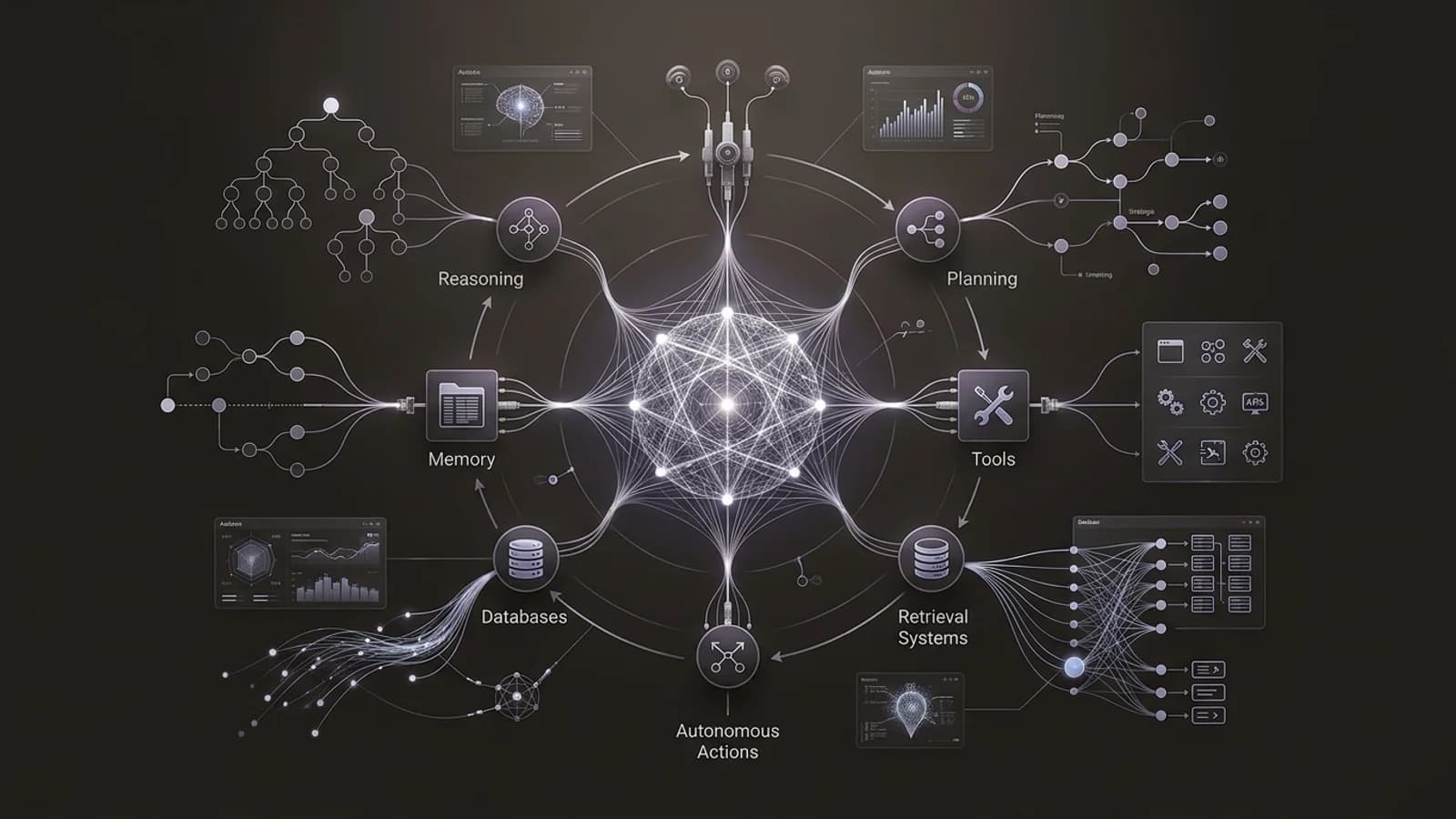
Agentic AI: The Next Era of AI
Generative AI & Agentic AI
Agentic AI refers to a new generation of artificial intelligence systems designed to operate with a greater degree of autonomy. Instead of simply responding to a single prompt or generating an answer, an AI agent can understand a goal, reason about the task, create a plan, use available tools, take actions, evaluate results, and adjust its approach when necessary.
Traditional AI applications are often designed around a direct input-and-output workflow: a user provides information, the model processes it, and the system produces a response. Agentic AI extends this workflow by allowing AI systems to work through multi-step objectives. An agent may decide what needs to be done, determine which tools or information sources are required, execute individual steps, and continue working toward the intended outcome.
Modern agentic systems can combine large language models with memory, planning, reasoning, tool use, retrieval systems, APIs, and external environments. This enables them to interact with software, databases, websites, business systems, and other digital tools rather than remaining limited to generating text.
The significance of Agentic AI lies in this shift from answer generation toward goal-oriented action. The AI is not necessarily limited to telling a user how to complete a task; within its authorized capabilities, it can participate in carrying out the task itself.
In simple terms: traditional AI primarily responds to instructions, while Agentic AI is designed to understand a goal, plan the required steps, use tools, take actions, and adapt its approach to complete the objective.
AI Evolution
The difference between traditional AI and Agentic AI is primarily about how the system approaches a task. Traditional AI is generally built to perform a specific operation in response to an input. A user provides a prompt, question, image, or data, and the model produces an output based on its training and the information available to it.
Agentic AI introduces a more dynamic workflow. Instead of stopping after producing an initial response, an agent can break a larger objective into smaller tasks, determine what information is needed, select appropriate tools, execute actions, inspect the results, and continue with the next step. This makes the system better suited to complex workflows that require multiple decisions rather than a single prediction or response.
| Capability | Traditional AI | Agentic AI |
|---|---|---|
| Primary role | Generates predictions, responses, or content | Works toward a defined goal through multiple steps |
| Workflow | Usually follows a predefined input-output process | Can plan and adapt its workflow dynamically |
| Tool usage | Often depends on external application logic | Can select and use authorized tools or APIs |
| Adaptation | Usually limited to the configured workflow | Can adjust its approach based on intermediate results |
| Task complexity | Well suited to focused, clearly defined tasks | Better suited to multi-step objectives and workflows |
For example, a conventional AI chatbot might answer a question about software development. An agentic system could take a broader objective, such as investigating an application error, examining relevant project information, selecting an appropriate diagnostic tool, analyzing the results, and proposing or executing an authorized solution.
This does not mean that Agentic AI is completely independent or capable of making unrestricted decisions. Its behavior depends on the model, instructions, available tools, permissions, memory, system architecture, and safety controls designed by developers. The key advancement is that the system can coordinate these capabilities to pursue an objective across multiple steps.
Key idea: traditional AI is often optimized to produce an answer, while Agentic AI is designed to move from understanding a goal to planning, execution, evaluation, and adaptation.
Agentic AI Architecture
Agentic AI is not a single technology or model. It is an architecture that combines several capabilities to enable an AI system to understand objectives, reason about problems, interact with external resources, and complete tasks through multiple steps. The exact architecture can vary depending on the application, but most capable agentic systems rely on a combination of reasoning, planning, memory, tool use, perception, and feedback.
These components work together as a continuous decision-making loop. The system receives a goal, interprets the available context, determines what should happen next, performs an action, observes the result, and then decides whether another action is required. This iterative process is what allows an AI agent to handle tasks that cannot be completed reliably with a single model response.
Interprets the objective, analyzes available information, and determines what actions may be required to reach the desired outcome.
Breaks complex objectives into smaller tasks and establishes an appropriate sequence for completing them.
Maintains relevant information from previous interactions, tasks, or retrieved knowledge so the agent can work with greater context.
Allows the agent to interact with APIs, databases, search systems, software tools, and other external resources.
Processes information from text, images, documents, sensors, software environments, or other available sources.
Evaluates intermediate results and helps the agent determine whether it should continue, revise its strategy, or finish the task.
| Component | What It Does | Why It Matters |
|---|---|---|
| AI Model | Provides language understanding, reasoning, generation, and decision-making capabilities. | Acts as the central intelligence responsible for interpreting tasks and selecting actions. |
| Planner | Converts a high-level objective into manageable steps. | Enables the system to approach complex problems systematically. |
| Memory | Stores or retrieves relevant information from previous tasks or external knowledge sources. | Provides continuity and additional context beyond the current interaction. |
| Tools | Connect the agent to search engines, APIs, databases, code execution, and other systems. | Extends the agent beyond what it can accomplish through model generation alone. |
| Feedback Loop | Reviews the outcome of an action and determines the next step. | Helps the agent recover from unsuccessful actions and refine its approach. |
| Guardrails | Define permissions, constraints, validation rules, and approval requirements. | Helps keep autonomous behavior controlled, predictable, and aligned with application requirements. |
Step 01
Interprets the user's objective, context, and constraints.
Step 02
Determines the tasks and sequence required to achieve the goal.
Step 03
Selects and executes an appropriate tool or action.
Step 04
Examines the result produced by the previous action.
Step 05
Continues, changes strategy, or completes the objective based on the result.
Imagine a business asking an AI agent to research a competitor and prepare a structured market report. The agent could first identify the research requirements, search authorized information sources, collect relevant data, organize the findings, analyze the information, generate the report, and review the result before presenting it to the user.
1. Goal
Understand the research objective.
2. Research
Gather information using approved tools.
3. Analyze
Compare and interpret the collected information.
4. Deliver
Produce and review the final market report.
Key takeaway: Agentic AI becomes powerful when intelligence, planning, memory, tools, feedback, and guardrails operate as a coordinated system. The model provides the intelligence, while the surrounding architecture enables it to turn that intelligence into structured, goal-oriented action.
Agentic AI Foundations
Agentic AI works through a continuous cycle of understanding, reasoning, planning, action, and observation. Instead of generating a response and immediately stopping, an AI agent can evaluate what needs to happen, determine the next appropriate action, execute that action through an available tool, inspect the result, and decide whether additional steps are necessary.
At the center of this process is an AI model, often a large language model (LLM), which provides the reasoning and language capabilities. Around the model, developers build an orchestration layer that manages the agent's state, tools, memory, instructions, permissions, and execution flow. This surrounding architecture is what transforms a language model into a more capable goal-oriented system.
The Agent Loop
The agent receives an objective together with relevant instructions, context, constraints, and available resources.
The system analyzes the request, available information, previous state, and constraints before deciding how to proceed.
The agent determines which steps, information sources, and tools may be required to accomplish the objective.
The agent calls an authorized tool, retrieves information, executes code, interacts with an API, or performs another permitted action.
The system examines the output of the action and determines whether it produced the expected result.
The agent either completes the objective or modifies its strategy and continues through another iteration of the loop.
A useful way to understand an AI agent is to view it as a decision-making system rather than simply a text generator. At every stage, the agent uses its current state and available information to determine what action should come next. The action may be another reasoning step, a retrieval operation, a tool call, a request for clarification, or a final response.
| Stage | Agent Question | Typical Operation |
|---|---|---|
| Understanding | What is the user trying to accomplish? | Analyze the goal, context, and constraints. |
| Planning | What needs to happen to reach the goal? | Create or select a sequence of tasks. |
| Tool Selection | Which resource can perform the next task? | Select an API, search tool, database, code executor, or other authorized capability. |
| Execution | What action should be performed now? | Execute the selected operation and capture its result. |
| Evaluation | Did the action move the task closer to completion? | Inspect the result and determine the next state. |
| Completion | Has the objective been successfully achieved? | Return the result or continue with another iteration. |
Tool use is one of the most important capabilities that separates many agentic systems from standalone language models. Tools give an agent access to capabilities that may not exist inside the model itself. Depending on the application, an agent may be connected to search services, databases, APIs, calculators, code execution environments, enterprise software, or internal knowledge systems.
Information
Retrieve current or domain-specific information from approved sources.
Data
Query structured information and use database results as task context.
Execution
Perform calculations, automate workflows, or interact with software systems through controlled interfaces.
Business
Connect agents with authorized business platforms and operational workflows.
Agentic systems may also use memory to maintain useful information across steps or interactions. Short-term context can help an agent remember what has happened during the current task, while longer-term memory systems can store selected information for future interactions. Retrieval systems can also provide relevant external knowledge when the model needs information that is not contained in its immediate context.
Maintains the current conversation, intermediate results, tool outputs, instructions, and task state required to complete the active workflow.
Stores selected information that can remain useful beyond the current task, often through dedicated storage or retrieval systems.
Key takeaway: Agentic AI works as a coordinated loop rather than a single prediction step. It combines a capable AI model with context, planning, tools, memory, execution, and feedback so the system can move from a high-level objective toward a completed result.
Agentic AI Capabilities
The defining strength of Agentic AI is not a single model capability, but the ability to combine multiple capabilities into a coordinated workflow. An effective agent can understand objectives, reason about available information, plan a sequence of actions, use external tools, maintain context, evaluate results, and adapt when the original approach does not produce the desired outcome.
These capabilities allow agentic systems to move beyond simple question answering and content generation. They can support complex workflows in which the system must gather information, make intermediate decisions, interact with software, and produce a final result based on what it discovers along the way.
Agents interpret high-level objectives and identify the intended outcome, constraints, available context, and requirements before taking action.
The system analyzes information and evaluates possible approaches to determine what should happen next.
Complex objectives can be divided into smaller tasks, allowing the agent to establish an execution strategy instead of relying on one predefined response.
Agents can interact with authorized tools such as APIs, search systems, databases, calculators, code environments, and business applications.
Memory and retrieval mechanisms provide relevant context from previous interactions, intermediate steps, or external knowledge sources.
When an action fails or produces unexpected results, the agent can reassess the situation and choose another available strategy.
| Capability | Description | Example |
|---|---|---|
| Reasoning | Analyze a problem and determine an appropriate next step. | Compare several possible solutions before selecting one. |
| Planning | Break a high-level objective into smaller executable tasks. | Divide a research project into search, analysis, and reporting stages. |
| Tool Calling | Select and interact with external capabilities. | Query a database or call an external API. |
| Memory | Retain or retrieve relevant information across task steps. | Use previously gathered information during a later stage. |
| Observation | Examine the result of an action before deciding what to do next. | Inspect an API response and determine whether another request is necessary. |
| Adaptation | Modify the strategy when circumstances or results change. | Try an alternative tool after an initial operation fails. |
Reasoning
Reasoning enables an agent to evaluate the current state of a task and determine an appropriate next action. Rather than treating every request as an isolated prompt, the system can consider previous actions, available information, constraints, and intermediate results.
Analyze
Understand the current problem and available information.
Evaluate
Consider possible actions and their expected outcomes.
Decide
Select the next action based on the current task state.
Individually, capabilities such as reasoning, memory, or tool calling are useful. Their real value becomes apparent when they operate together. A capable agent can use reasoning to identify a task, planning to structure it, tools to interact with the outside world, memory to maintain relevant context, and feedback to determine whether its actions are producing the intended result.
The combination of these capabilities allows AI systems to participate in multi-step workflows instead of being limited to producing isolated responses.
Agents can respond to changing conditions and intermediate results, making their behavior more flexible than a strictly predefined sequence.
Key takeaway: the power of Agentic AI comes from orchestration. Reasoning, planning, tools, memory, observation, and adaptation work together to transform an AI model from a response generator into a system capable of pursuing multi-step objectives.
Agentic AI Architecture
An Agentic AI system is more than a large language model connected to a chatbot interface. It is a coordinated software architecture in which multiple components work together to transform a high-level objective into a sequence of decisions and actions. The architecture determines how an agent understands its environment, maintains state, accesses knowledge, selects tools, executes operations, evaluates results, and decides what to do next.
Although implementations differ across applications, a typical agentic architecture contains several foundational layers. The AI model provides reasoning and generation capabilities, while orchestration logic controls the workflow. Memory and retrieval provide context, tools connect the agent to external systems, and guardrails define what the agent is permitted to do.
Architecture Overview
The following architecture illustrates how the major components of an agentic system can work together during a typical task.
Input
Objective, requirements, and constraints
Context
Relevant history and retrieved knowledge
Intelligence
Reasoning, planning, and decision-making
Execution
APIs, databases, search, and software
Control
Permissions, validation, and safety rules
A useful way to understand an agentic architecture is to separate it into logical layers. These layers do not always exist as independent software modules, but they represent the major responsibilities that must be handled by a reliable agent.
The interaction layer receives requests from users or other applications. It converts the incoming request into structured information that the agent can process. This layer may include a chat interface, voice interface, API endpoint, enterprise application, or automated event.
User Request
Defines what the user wants to accomplish.
Context
Adds relevant information and constraints.
Output
Delivers the completed result to the user or application.
This layer determines how the agent should approach the objective. The AI model interprets the task, identifies relevant information, considers possible actions, and creates or updates an execution plan. Depending on the system, planning may happen once at the beginning or repeatedly as new information becomes available.
Agents often require more information than can be supplied in a single prompt. Memory and retrieval systems provide relevant information from previous interactions, internal knowledge bases, documents, databases, or other approved sources.
Retrieval-augmented generation (RAG), vector databases, structured storage, conversation history, and application state can all contribute to this layer. The goal is not to remember everything, but to provide the right information at the right stage of the task.
Tools provide the agent with capabilities beyond language generation. A tool can expose a specific operation through a controlled interface, allowing the agent to retrieve information, perform calculations, query a database, call an API, or interact with another software system.
Search
Retrieve relevant information from approved sources.
APIs
Communicate with external applications and services.
Databases
Read or update authorized structured information.
Code
Perform controlled computation or programmatic operations.
After an action is executed, the agent needs to understand what happened. The observation layer captures the result and makes it available to the reasoning process. If the result is successful, the agent may continue to the next task. If the result is incomplete or unexpected, the agent can revise its approach.
Autonomous behavior requires boundaries. Guardrails can restrict which tools an agent can access, validate inputs and outputs, enforce permission rules, require human approval for sensitive operations, and prevent actions outside the application's intended scope.
The architecture becomes easier to understand when viewed as an execution workflow. Consider an agent that receives a request to prepare a business report using information from several approved sources.
| Step | Agent Activity | System Component | Result |
|---|---|---|---|
| 01 | Interpret the business reporting objective. | Interaction + AI Model | A structured understanding of the task. |
| 02 | Identify required information and subtasks. | Planning | An execution plan. |
| 03 | Retrieve relevant information. | Memory + Retrieval | Relevant evidence and context. |
| 04 | Call required external tools. | Tool Layer | New information or completed operations. |
| 05 | Inspect tool results and compare them with the objective. | Observation + Reasoning | A decision about the next step. |
| 06 | Generate, validate, and deliver the report. | AI Model + Guardrails | Final validated output. |
Not every agent follows the same execution strategy. Some systems create a plan before taking action, while others decide one step at a time based on the latest observation. More advanced systems can combine both approaches, creating an initial plan while remaining flexible enough to revise it when new information becomes available.
Approach 01
The agent creates a sequence of tasks before execution begins. This can make complex workflows easier to structure and monitor.
Best suited for
Structured research, project workflows, and multi-stage processes.
Approach 02
The agent determines the next action after observing the current state. This approach can be useful when the environment is unpredictable.
Best suited for
Dynamic environments and tasks where results determine the next step.
Approach 03
The system creates a high-level plan but continuously evaluates results and modifies individual steps when necessary.
Best suited for
Real-world workflows that require structure and flexibility.
A multi-step agent needs to know what has already happened. State management provides a structured representation of the current task, including the objective, previous actions, tool results, retrieved information, intermediate decisions, and remaining work.
Without reliable state management, an agent may lose track of previous operations, repeat actions unnecessarily, or make decisions without the required context. For production systems, explicit state handling is therefore an important part of making agentic workflows observable, testable, and maintainable.
Goal
What the agent is trying to accomplish.
History
What the agent has already done.
Current State
What is happening at the present stage.
Next Action
What the system should attempt next.
Key takeaway: an Agentic AI system is best understood as an orchestration architecture, not simply as an AI model. The model supplies intelligence, while planning, memory, tools, state management, feedback, and guardrails turn that intelligence into a controlled multi-step workflow capable of pursuing real-world objectives.
Agentic AI Systems
Agentic AI systems can be designed in different ways depending on the complexity of the task, the number of agents involved, the level of autonomy required, and the environment in which the system operates. There is no single architecture that fits every application. A simple agent may perform one task using a small set of tools, while a more advanced system may coordinate multiple specialized agents to complete a large objective.
Understanding these different patterns is important because the most sophisticated architecture is not always the best choice. A production system should use the simplest architecture capable of reliably completing its intended task while maintaining appropriate control, observability, and safety.
Type 01
One AI agent manages the complete workflow, using reasoning, memory, and a collection of authorized tools to accomplish the objective.
Type 02
Multiple specialized agents collaborate, with each agent responsible for a particular role, capability, or stage of a larger workflow.
Type 03
Agents interact with external tools such as search engines, APIs, databases, calculators, code environments, or business applications.
Type 04
Agents operate inside a structured workflow where predefined stages and decision points guide autonomous execution.
Type 05
These systems receive a high-level objective and determine a larger portion of the required steps dynamically.
Type 06
The agent can perform autonomous work while requiring human review or approval for important decisions and sensitive actions.
One of the most important architectural decisions is whether a workflow should be handled by a single agent or divided among multiple specialized agents. A single-agent architecture is often easier to develop, test, monitor, and maintain. A multi-agent architecture can be useful when the problem naturally contains several distinct responsibilities that benefit from specialization.
| Factor | Single Agent | Multi-Agent |
|---|---|---|
| Architecture | One central agent manages the workflow. | Multiple agents collaborate or coordinate. |
| Complexity | Generally simpler to implement and operate. | Requires additional coordination and communication logic. |
| Specialization | Capabilities are managed by one agent. | Different agents can specialize in different tasks. |
| Debugging | Usually easier to trace and diagnose. | More difficult because multiple agents and interactions must be observed. |
| Best Use | Focused workflows with several related capabilities. | Complex workflows requiring distinct areas of expertise. |
Tasks are executed in a defined sequence. The output of one stage becomes the input for the next stage.
Example workflow
A higher-level agent coordinates specialized agents and delegates individual tasks according to the requirements of the overall goal.
Example structure
Multiple agents work on different parts of a problem and exchange information before a final result is produced.
Example workflow
The agent performs routine work autonomously but pauses at predefined checkpoints when human confirmation is required.
Example workflow
Agentic AI should also be evaluated by how much control the system has over its workflow. Autonomy is not simply a choice between manual and fully autonomous operation. Production systems can be designed across a range of autonomy levels, with appropriate human oversight and technical controls.
| Level | Agent Behavior | Human Role | Suitable Use |
|---|---|---|---|
| Assisted | Suggests actions or generates recommendations. | Makes the final decision. | Decision support and productivity. |
| Supervised | Performs selected tasks but pauses for important approvals. | Reviews critical actions. | Business workflows and controlled automation. |
| Semi-Autonomous | Executes multiple steps independently within defined boundaries. | Monitors exceptions and high-impact decisions. | Multi-step operational workflows. |
| Highly Autonomous | Manages substantial portions of a workflow within strict permissions and controls. | Provides oversight, governance, and intervention when required. | Large-scale automation with strong monitoring. |
The right architecture depends on the actual requirements of the application. Developers should consider task complexity, reliability requirements, tool access, latency, cost, security, observability, and the consequences of incorrect actions before increasing the level of autonomy.
Task Complexity
More complex objectives may benefit from planning or specialized agents.
Reliability
Critical workflows require validation, monitoring, and controlled execution.
Cost & Latency
Additional agents and model calls can increase system complexity, latency, and operational cost.
Risk
Higher-impact actions should have stronger permissions, validation, and human oversight.
Key takeaway: Agentic AI can range from a simple tool-using assistant to a coordinated multi-agent system. The best architecture is not necessarily the most autonomous one; it is the architecture that reliably solves the intended problem while maintaining appropriate control, transparency, security, and human oversight.
References & Further Reading
Agentic AI brings together large language models, reasoning, planning, memory, tool use, retrieval, and autonomous decision-making. The following resources provide additional technical and conceptual context for readers who want to explore agentic systems, generative AI, AI agents, and modern AI architectures in greater depth.
AI Agents
```Explore the foundations of AI agents, including autonomous decision making, task execution, reasoning, planning, and interaction with external environments.
Generative AI
Learn how large language models provide the reasoning and language capabilities that increasingly power modern agentic AI applications.
AI Architecture
Study how agents combine models, tools, APIs, memory, retrieval, planning loops, and external systems to complete multi-step tasks.
Responsible AI
Responsible agentic AI requires evaluation, permission boundaries, observability, human oversight, security controls, and reliable mechanisms for handling uncertain or high-impact decisions.
| Topic | What to Explore | Why It Matters |
|---|---|---|
| Large Language Models | Foundation models, prompting, reasoning, context, and inference | LLMs often provide the core intelligence layer of modern agents |
| Retrieval-Augmented Generation | Embeddings, vector databases, retrieval, and grounded generation | Gives agents access to external knowledge and private data |
| Tool Calling | APIs, functions, databases, browsers, and external services | Allows agents to move beyond text generation and take action |
| Multi-Agent Systems | Agent collaboration, delegation, communication, and coordination | Enables complex workflows to be divided across specialized agents |
| AI Safety & Evaluation | Guardrails, monitoring, testing, permissions, and human approval | Helps make autonomous systems reliable, secure, and controllable |
Editorial note: Agentic AI is an evolving field. Concepts, architectures, frameworks, evaluation methods, and best practices continue to develop rapidly. Readers should consult current technical documentation and research when implementing production-grade autonomous AI systems.

Editor in Chief
Software engineer and full-stack developer building modern digital experiences, products, and ideas.
sudaisazlan.comReady to do everything better? Get daily tips, tricks, and tech guides from our expert team.
By clicking Sign Up, you confirm you are 16+ and agree to our Terms of Service and Privacy Policy.
Have fun. Be respectful. Feel free to criticize ideas, but not people.